


Every September the same thing happens. The shops start putting out Christmas stock, everyone complains it’s too early but quietly grows their Christmas Wishlist and then nobody does anything about it until mid December.
Here’s the thing: the shops are right.
Financially savvy people have been putting a little aside every month since January. If you haven’t started yet, September is the last month where catching up is still easy. Three paydays go a long way.
So this is the autumn lock-in, 2026 edition. Same idea as last year, but this time the whole thing points at one goal: walking into Christmas with the money already there.
In this issue:
Why September is the right month to reset your money, not January
How to work out your Christmas number in ten minutes
The pot, the standing order and where to keep it
The conversations to have now, not on the 20th
What to cull so the pot fills itself
The autumn spending traps that undo all of it
Why September instead of January
I wrote about this in Know your financial season. Just like you have seasons in your life where you focus on various priorities, your money has seasons too. Summer is for experiences, winter is for friends and family, autumn is the build season or the “lock in” season as Gen Z loves to call it, when you set the money up so that winter runs itself.
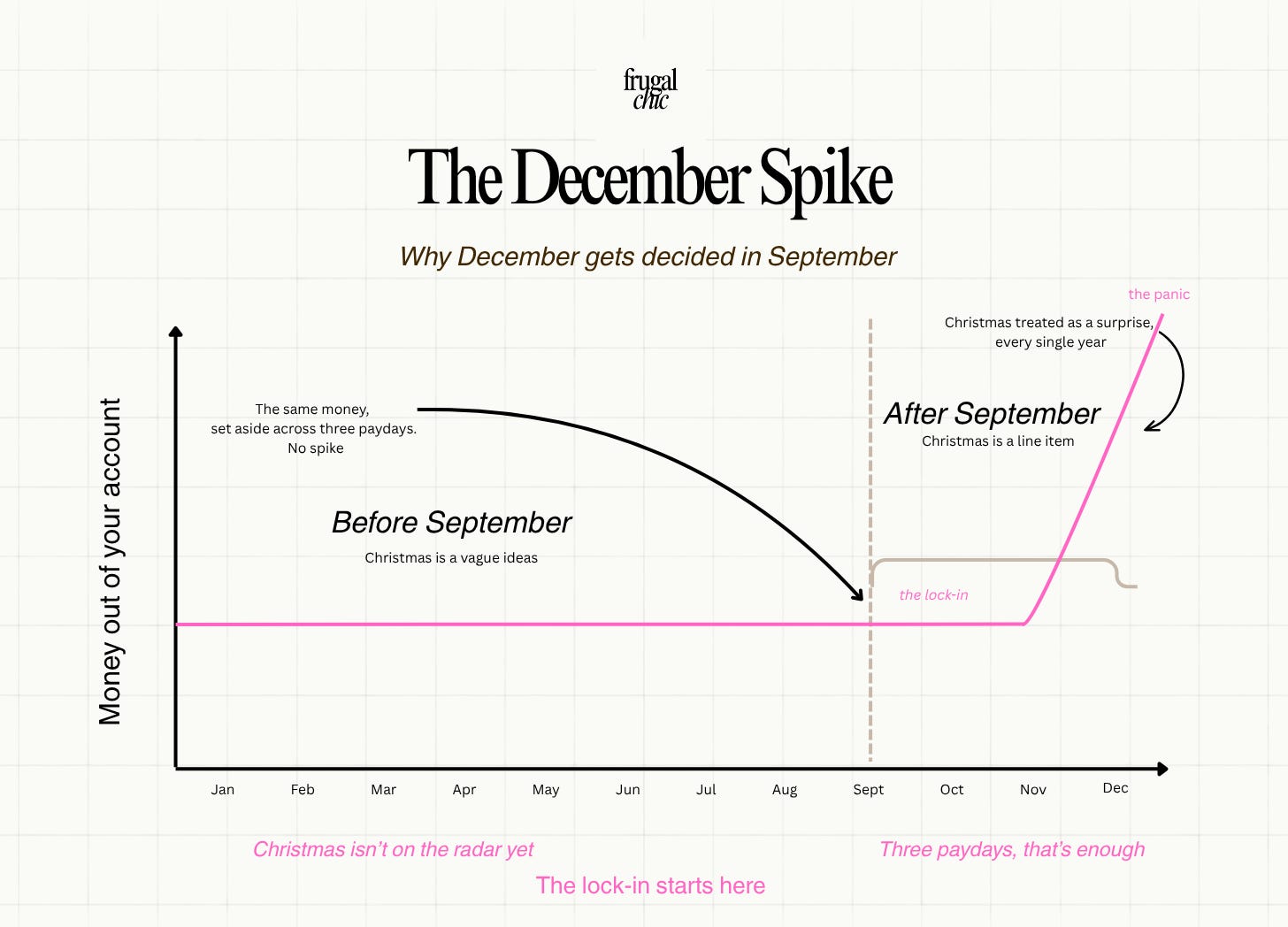
January resets tend to fail because by the time a new year unfolds the damage is already done. September gives you three paydays before Christmas. That’s enough to make a change.

1. Work out your Christmas number
Christmas is the most predictable expense of the year, and it still catches people out.
Nearly one in five UK adults borrowed money to cover Christmas 2025, mostly for presents. The Bank of England estimates households spend around £700 more in December than in a normal month.
It isn’t a surprise. It’s almost an annual subscription most people forget to budget for.
So work out yours: presents, food, travel, going out, the Christmas Party or New Year’s Eve outfit.
Go through last December’s statement if you need to, and write the total down.
Divide it by the number of paydays between now and when you want the money in hand.
If you’re paid monthly and you want it ready for December, that’s three paychecks.
That’s your monthly Christmas number.
2. Open the pot and automate it
The frugal chic® version of this is putting a little aside every month from January. If you haven’t already, September isn’t too late. It’s just a bit more per month.
Open a separate pot and name it “Christmas Fund”.
Set up a standing order for your monthly number, the day after payday, so it’s gone before you can spend it.
The Frugal Chic® rule: never save for Christmas in your current account. If it can be spent, it will be.
3. Decide what Christmas looks like now, not on the 20th
The pot covers the money and this covers the expectations.
In September there’s still room to have the conversations you can’t have in December.
A secret Santa instead of buying for all eight cousins.
A price cap with your friends.
The adults skipping presents this year.
Nobody minds in September.
Then think about what you’d give if money wasn’t the point. A day out you plan and pay for. A printed photo in a frame. Something you cooked or wrote.
The gifts people are still talking about in the years to come and are rarely the expensive ones.
4. Cull before the pot fills
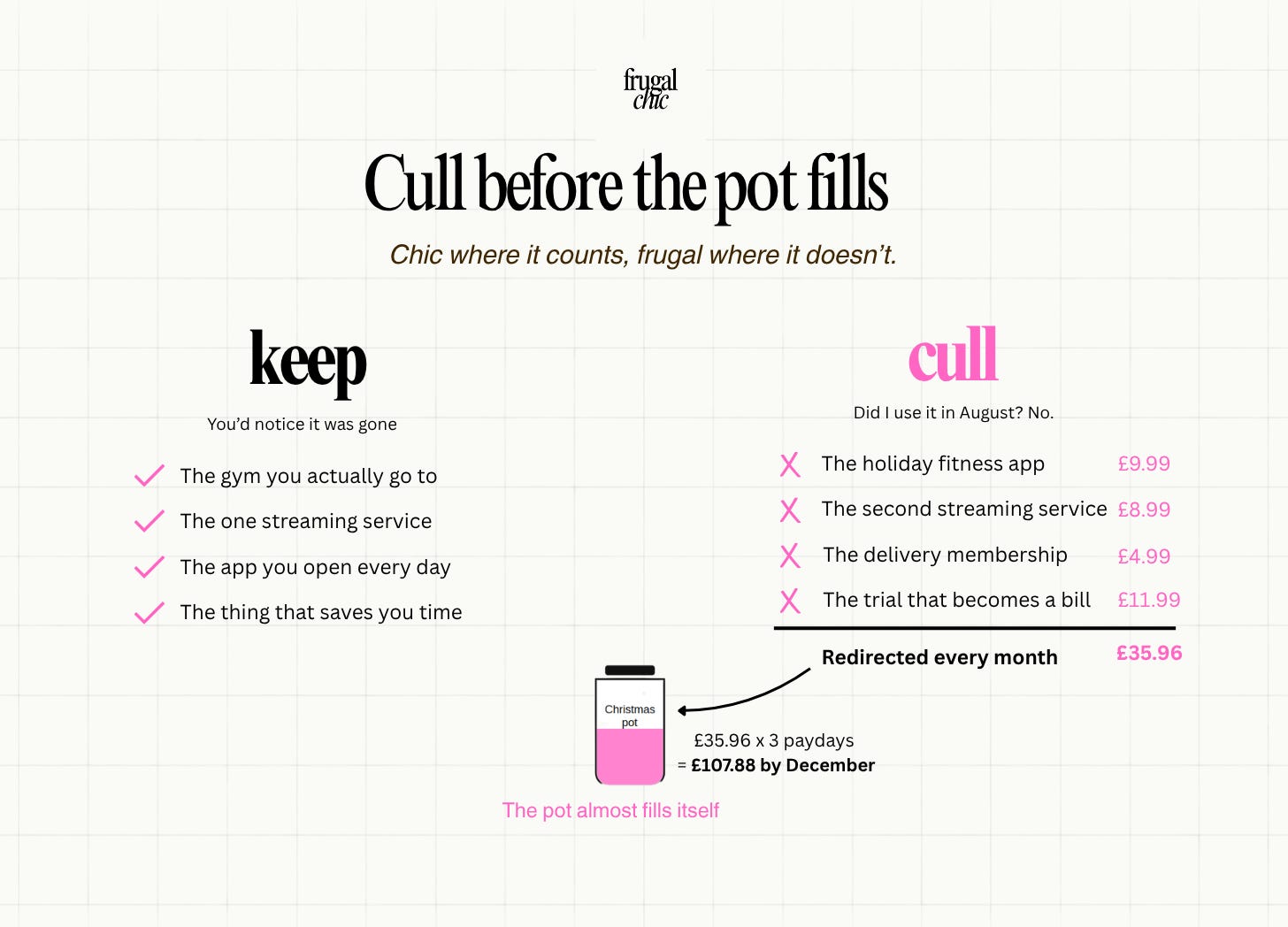
Every September I go through every direct debit and app subscription and ask one question: did I use this in August?
Not “will I use it”. Did I use it.
If not, it goes. I can always re-subscribe if there is a need for it, but most of the time, there' isn’t.
The frugal chic rule I live by is to be chic where it counts, and frugal where it doesn’t.
On that note, look for the summer subscriptions: the holiday fitness app, the second streaming service, the delivery membership you needed for that one heatwave. If this isn’t something you use regularly, get rid of it.
Whatever you cancel, redirect it straight into the Christmas pot. That almost makes the pot fill itself.
5. Watch for the autumn spending traps
I’ve been on a low-buy year since January, and for most people, September is where discipline starts to slip.
That’s not because a low-buy is deprivation. It isn’t. At least I don’t see it that way.
It often happens because after eight months of considering every purchase, a small voice says you’ve earned one impulse buy.
The weather is getting cold, you’ve been “good” for so long, the knitwear is calling.
The cosy tax: candles, new pyjamas, home décor. All of these are items you might want but there’s a recurring “need” for it every year. You should remember that last year’s pumpkin pillows are still fine and there’s nothing wrong with the pyjamas you’re wearing at the moment.
What keeps me going is remembering why I started. Spending intentionally has kept my flat clutter-free, my savings have gone up rather than just moved around, and I want less.
So write down the one thing you’re tempted by, and give it until the 1st of December, then reevaluate.
6. Plan December before December
The most expensive thing about December isn’t buying presents. It’s the six friends & family dinners, three drinks and two work parties that land in the span of three weeks.
Look at your calendar now and decide how many you’ll say yes to. Book the train while it’s a quarter of the price. These small decisions you start making now will add up by the time December comes around.
Style lens: the knit goes on the list, not in the basket
The thing I’m tempted by this autumn is knitwear: natural fibres, the kind that’s expensive to buy and lasts for years.
So it goes straight on my Christmas list. If it’s still the thing I want in December, it’s either the one gift I ask for or the one thing I buy with a clear head.
That’s how a low-buy survives autumn: the want doesn’t disappear, it just gets a date.
And if you’re the one buying it, for yourself or someone else, buy it properly.
This is something my friend actually shared with me and it’s quite an interesting fact.
It isn’t only the fibre, it’s the gauge: how densely it’s knitted. Feel the weight, hold it to the light, stretch the cuff. A dense merino outlasts a thin cashmere every time, and that’s what makes it a gift rather than a purchase.
So if you want to start your money reset in September, here’s where I’d start:
Work out your Christmas number
Open the pot and automate it
Decide what Christmas looks like now
Cull before the pot fills
Watch the autumn traps
Plan December before December
The key takeaway here is: Christmas isn't expensive. December is. Spread it across three paydays and it's just another month.
That’s all this week,
Mia xx
P.S. Wednesday's paid post is the one I've been circling for months: how much is enough? I'm going through the studies on whether money actually buys happiness (spoiler, they disagree), why lifestyle creep is just golden handcuffs you put on yourself, and how I use investing, side income and equity to stop trading every hour for every pound. If you've been meaning to upgrade, this is the one.