


What do we consider luxury now?
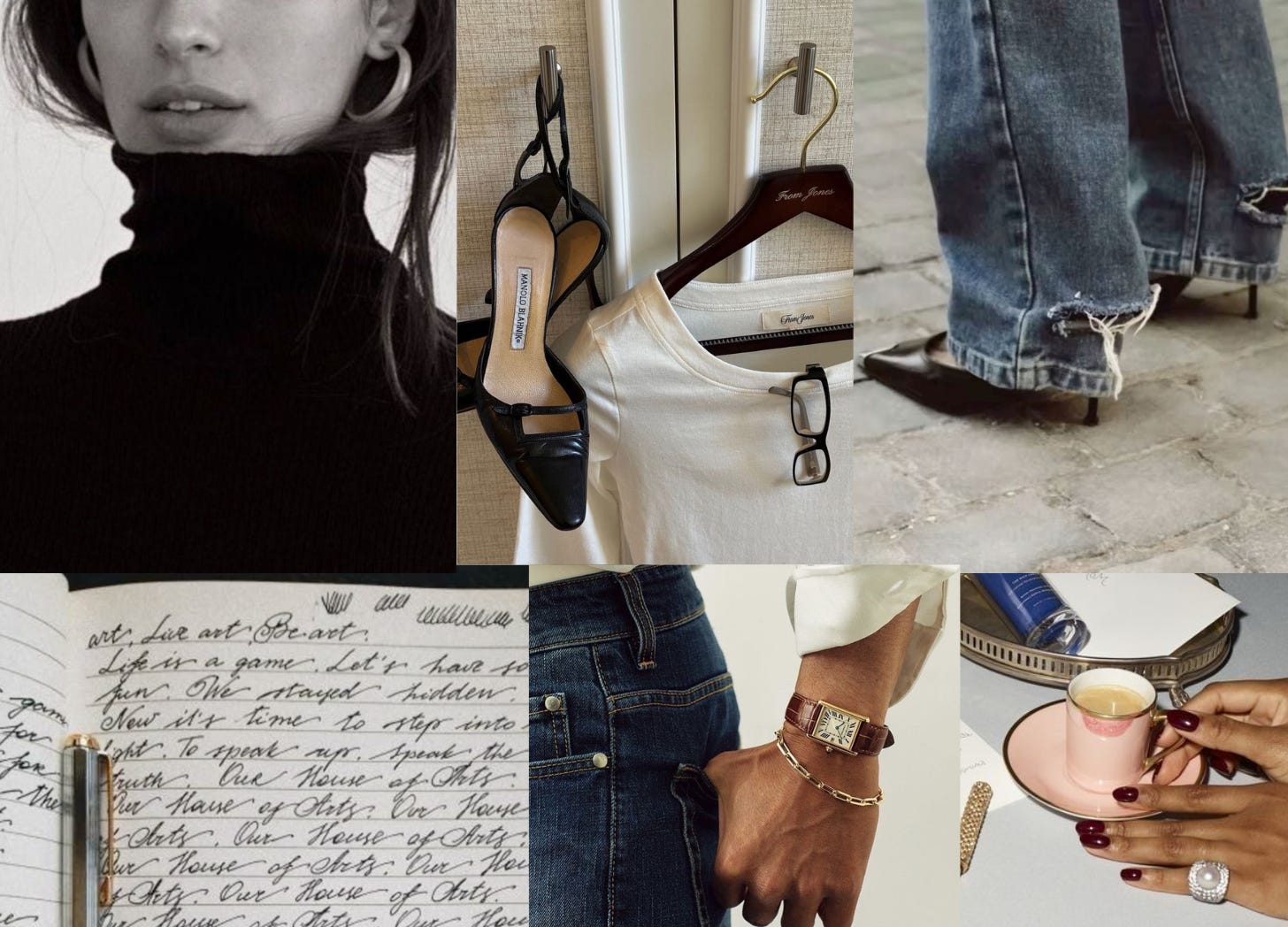
The Oxford Dictionary describes it as a state of great comfort or elegance, especially when involving great expense.
I would consider a few other things.
An excess. Anything that goes beyond a typical need or want.
It’s symbolic, while premium products signal value, luxury doesn’t try to prove itself - it’s for those that want to become more, not have more.
It often signals greater cultural capital and is usually scarce.
A privilege. Having no reason to rush, or having freedom over your time, can also be seen as a luxury.
When I was growing up in the 2000s, I saw luxury as living in a metropolitan city, in a high-rise apartment, riding on the back of a motorcycle with a silk scarf tied around my head. You know those graphics that sold us the idea of adulthood, like MyScene. The artist Jason Brook’s work pretty much summarises this. That was my image of a luxurious life, or a rich life.
In my teenage years, we saw the rise of logomania in fashion. It was cool to flex branded items from Gucci, Balenciaga, and streetwear brands like Supreme and Palace. Luxury was about being bold and maximalist.
Then we saw the reign of quiet luxury and the old-money aesthetic, with brands like Loro Piana becoming status symbols. We quickly got tired of this as brands like Pretty Little Thing rebranded and easily replicated the aesthetic at scale.
Luxury is something that is difficult to replicate, the opposite of mass-produced. In an age where any luxury brand can send PR to an influencer or can be counterfeited indistinguishably, it feels that the older notion of luxury no longer reigns.
All this time, we were debating whether a bold logo meant luxury, but what if the new luxury isn’t about things at all?
I predict that the new luxury is frugality with your money and your time. Frugality has always carried baggage. To most people, it means sacrifice. The word conjures images of stinginess, penny-pinching, and deprivation. But that definition is wrong. Frugality isn’t about doing without. It’s about doing with. Doing with intention. Doing with clarity. Doing with the quiet confidence of someone who knows exactly what matters to them and isn’t afraid to edit out the rest.
As Morgan Housel famously writes in The Psychology of Money: ‘Wealth is what you don’t see.’ The wealthiest person in the room often isn’t the one draped in designer labels or jewellery. It’s the one quietly compounding their investments, maxing out their ISA, and building a future while everyone else is performing wealth for external validation.
What you choose not to waste resources on matters more than what you buy. In an age of excess and distraction, having a clear vision and the discipline to follow it is the true signal of status. Being selective with where you put your energy and attention becomes the point.
Here’s the thing: frugal on its own has never sounded particularly glamorous. But when you add chic? Everything shifts.
I’ve always admired classic style icons like Carolyn Bessette Kennedy, Princess Diana and even modern examples like Zoë Kravitz. Of course, these are all examples of wealthy people but you can see that despite that, they dress minimally, because they wear the clothes, not the other way around.
Chic is about aesthetics, taste, and curation. It says: I choose carefully, I care deeply, I live with style. The Frugal Chic philosophy isn’t about denying yourself - it’s about saying yes to what you care about and trimming the excess.
When you combine the two, you end up with a balanced view. That priorising financial stability is important, but so is the now.
So what does this look like?
Being generous with your time on activities that enrich you. Reading classics and philosophy, going to a chess club or a pottery class, spending an afternoon having a bath or going for a long walk and buying local or independent.
This could mean reduced screen time. We know analog is trending, but without ditching our iPhone for a brick, we can still practice more intentionality here. Short form scrolling is the digital equivalent to fast food. So, spending more time with long form could look like listening to a podcast while cleaning, watching a foreign film or reading a book while commuting.
Think of it like editing your wardrobe. You don’t need thirty versions of the same polyester top that doesn’t fit quite right. You need three pieces that make you feel unstoppable every time you put them on.
Saying no to what doesn’t align with your goals, the eighth open tab, the third drink, to the calendar invite that would drain you. The hardest flex in 2026 isn’t a limited-edition handbag. It’s a quiet schedule and a regulated nervous system.
It’s about becoming more, while owning less. Figuring out what truly matters in life and doubling down on that. Creating more than consuming, and building a tasteful life slowly. It’s aligning your behaviour with the person who knows where her money goes, saves without suffering, spends with meaning, and invests confidently.
How to be frugal chic in your life:
Audit your spending for emotional ROI. Ask yourself whether a purchase brings lasting value or just momentary dopamine. Refer to your wish-list for 24 hours before buying anything non-essential.
Create a luxury roster. Decide which categories are worth the splurge and which aren’t. Make those splurges guilt-free and cut everything else.
Guard your calendar like your wallet. If time is the new luxury, treat invitations the way you treat your bank account, with intention. Declining an obligation frees up space to rest, reflect, or work on your passion project.
Invest in future you. Automate contributions to your savings and investment accounts. Align your habits with your identity as a calm, confident investor.
Celebrate the void. That feeling of “I should be buying something” is often discomfort with space and stillness. Learn to sit with it. The richest life might be the one where you don’t feel compelled to fill every gap.
In 2026, frugality is more than a financial strategy. It’s a lifestyle shift toward conscious abundance, the kind of wealth that cannot be faked or mass-produced. The next time you see a luxury unboxing, ask yourself whether that’s luxury, or whether luxury is the peace of mind that comes from knowing you’re building the life you actually want.
I like the idea that you mention, trimming the “not needed/necessary”. I feel as if true luxury is knowing what brings you happiness and/or peace and being able to act on it. And what is superfluous and does nothing to move you towards your goals can just be cut because it’s a waste of mind space
I love this. The idea of a luxury roster is so smart! Immediately I thought about sweaters as the thing that’s worth splurging on for me, and that’s kind of freeing to realize.