


I am a recovering people-pleaser, and if also are one, nothing tests that more than a group chat.
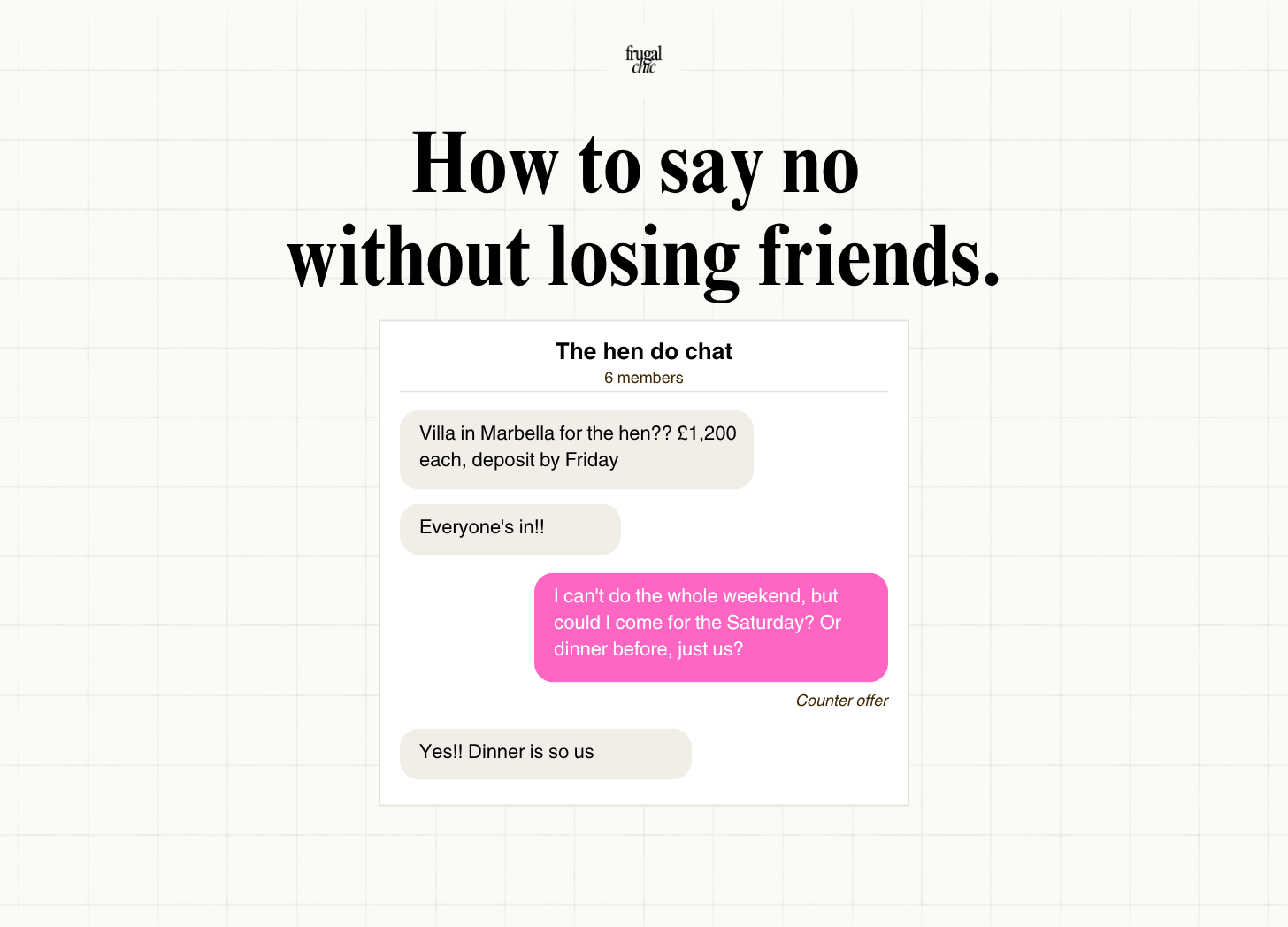
You know that moment when someone drops a link to a villa and everyone else replies with the heart eyed emoji. Before you even get the chance to think about the trip plan that is so quickly developing, there’s a deposit deadline, and you’re doing maths in your head…and somehow, even if it’s not budgeted for you find yourself typing “omg YES”.
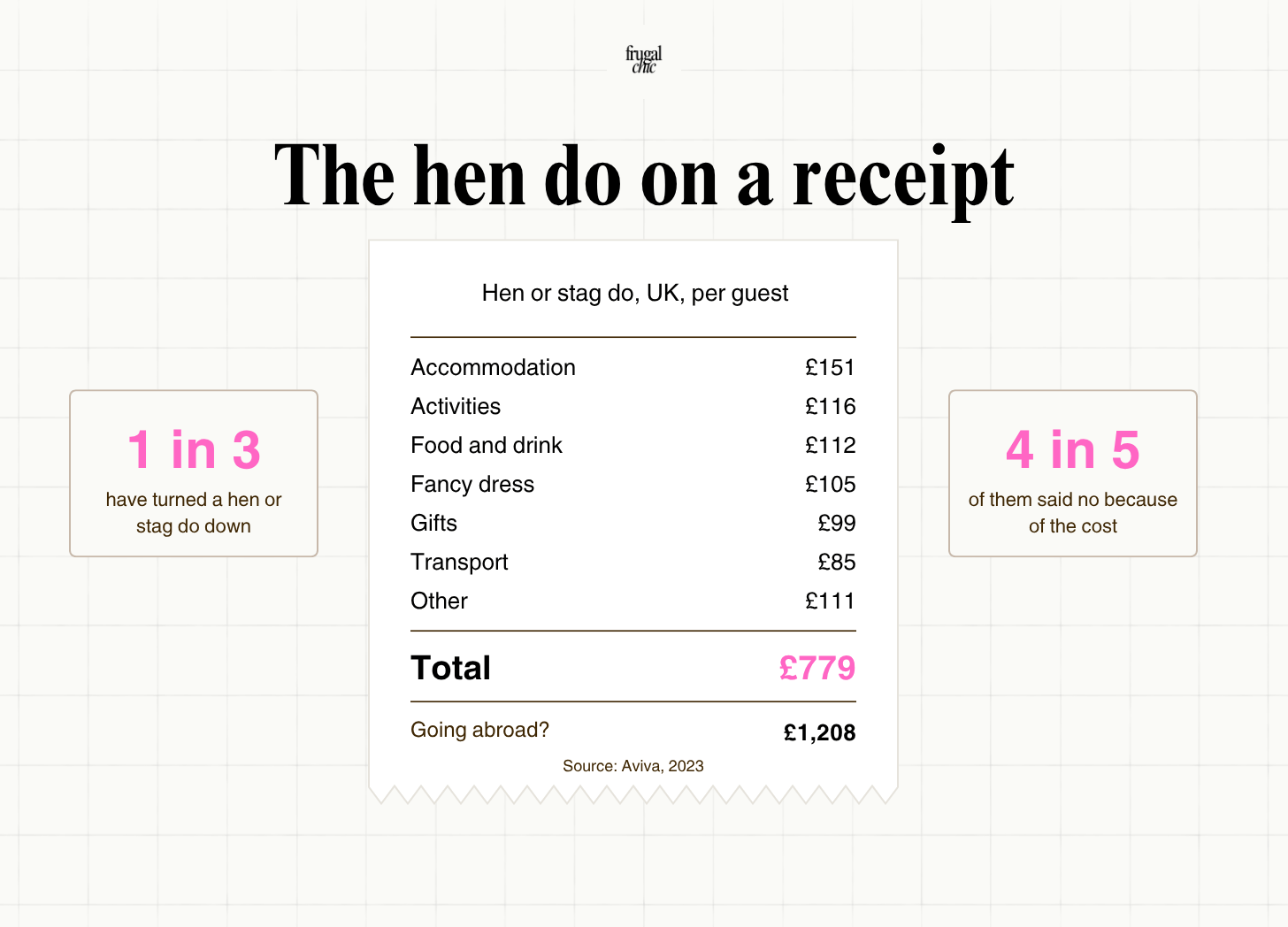
If that sounds familiar, you’re in good company. When Aviva asked people who’d been to someone else’s hen or stag do, around a third said they’d turned an invitation down, and in nearly eight out of ten cases the reason was money. Some of them didn’t tell the host that. they gave a different excuse instead.
That’s the bit I want to discuss today. Not the saying no part, you’re allowed to say no, it’s actually good because you’re staying true to your goals if the trip, night out or even Secret Santa didn’t make the cut in your budget.
I want to help you deal with the “making something up” part. December’s invitations are about to land, so here are some things you can say instead of fabricated information.
In this issue:
The one rule that makes a “no” land softly
Scripts for seven of the priciest invitations, from the split bill to the wedding abroad
Three ways to say each one: a soft no, a counter offer and a firm no
The three habits that turn a no into an excuse
1. Swap the excuse for an alternative
An excuse closes the door to plans. When you say “I’m busy”, that tells your friend nothing, and if they find out you weren’t busy, it tells them something worse.
An alternative keeps the door open. It says: “I want to be part of X, I just don’t want this price tag.” Most friends only ever needed to hear the first half.
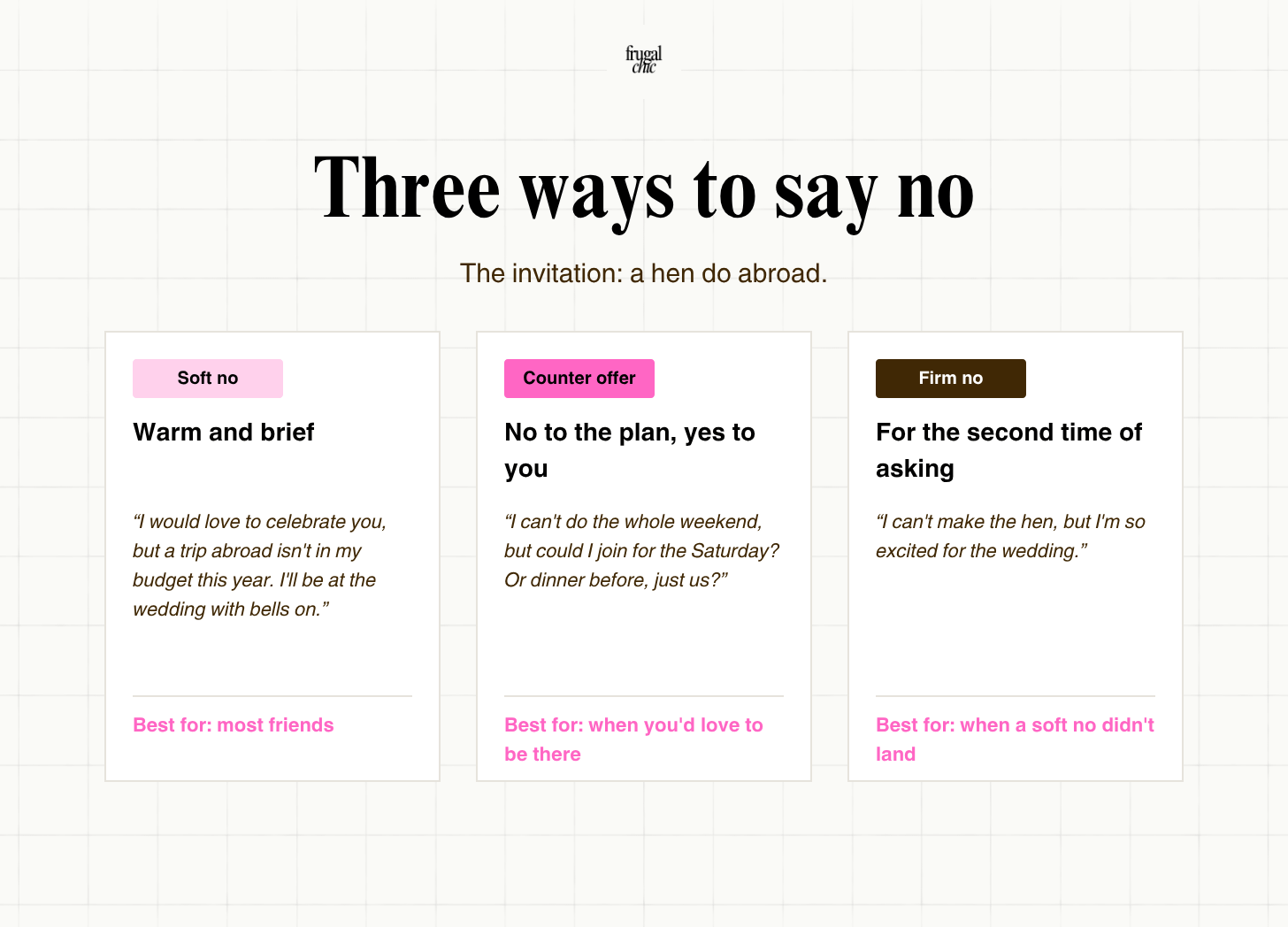
Every script below comes in three versions. The soft no is warm, brief and drama free. The counter offer says no to the plan and yes to the person. The firm no is for the second or third time of asking. You will know your friendship dynamics best so pick the one that fits each friend or friend group.
The Frugal Chic® rule: Say no to the plan, not the person.
Ever wondered why making up an excuse feels easier than saying “I can’t afford it”? Usually it’s a line someone handed us years ago. “It’s rude to talk about money.” “Don’t be tight.”

2. The everyday plans
These are the small ones, and they add up fastest, because they can happen every week. If you have a group of work colleagues, this can occur multiple times a week: going out for food during your lunch break, going out for drinks after your shift is over and going out during the weekend.
The group dinner where you split the bill
Soft no: “I’m in! I’m keeping things light this month though, so I’ll just pay for what I have.”
Counter offer: “Could we try (cheaper restaurant) instead? I’d love to come and it’s much more my budget right now.”
Firm no: “I’m going to sit this one out, I hope you have the best night.”
The friend who always picks the expensive place
Soft no: “Do you mind if I choose next time? I’ve found somewhere you’ll love.”
Counter offer: “I’m in for dinner, but can we do [place] instead? It’s more my speed at the moment.”
Firm no: “I love seeing you, but I can’t keep doing places like this every time. Let’s find somewhere that works for both of us.”
“Just come for one”
Soft no: “We both know one is never one with us! Next time.”
Counter offer: “I’m heading home, but come round for breakfast on Saturday.”
Firm no: “Not tonight. I’ve told myself I’m having an early night and I’m sticking to it, but I love that you asked.”
3. The big celebrations
Aviva put the average spend on someone else’s hen or stag do at £779 in the UK and £1,208 abroad. That’s a lot to hand over for a weekend you only said yes to because you felt you had to.
The hen do or the wedding abroad
Soft no: “I would love to celebrate you, but a trip abroad isn’t in my budget this year. I’ll be at the wedding with bells on.”
Counter offer: “I can’t do the whole weekend, but could I join for the Saturday? Or let me take you out for dinner before, just the two of us.”
Firm no: “I can’t make the hen, but I’m so excited for the wedding.”
The birthday with a price tag
Soft no: “I can’t stretch to the (bottomless brunch) this time, but I really want to see you for your birthday.”
Counter offer: “Can I take you for a birthday coffee the week after? My treat.”
Firm no: “I’ll miss this one, but I’ll be raising a glass to you from the sofa.”
4. The Christmas season
This is the hardest one to say no to because everyone loves the festive season. You meet up with people you haven’t seen for months, or all year maybe, and it almost feels illegal to say no to. It’s the end of the year break we are all looking forward to. If you want to change the trajectory of your spending this year, put these in your Notes app now because you’ll need them by November.
Secret Santa
Soft no: “Could we do a £20 limit this year? I think a few of us would be quietly grateful.”
Counter offer: “What about a secondhand Santa? Everything has to come from a charity/vintage shop. I think it would make it more fun.”
Firm no: “I’m going to sit Secret Santa out this year, but I’m bringing the mince pies.”
Work drinks and the collection
Soft no: “I’ll come for the first one, but I’ll get my own rather than go in on rounds if that’s okay.”
Counter offer: “Could we do a team lunch next time? Easier for everyone to get to.”
Firm no: “I’ve signed the card and put in what I can, I need to stick to my budget.”

5. Stop explaining, apologising and inventing
Over-explaining. The longer your reason, the more room there is to argue with it. “I can’t, money’s a bit tight” is a full sentence. A three-minute voice note about your car insurance renewal is an open invitation for someone to offer to pay, or to fix your budget for you. It’s also an opportunity, for someone else who knows nothing about your budget, to say: “You only live once, you’ll miss out on so much fun.”
Apologising. “Sorry, sorry, I feel so bad” tells your friend you’ve done something wrong, but you haven’t. Swap “sorry I can’t come” for “thank you so much for inviting me”. It’s the same message, shows gratitude, but sends off a completely different energy.
Making things up. This is the one from the Aviva survey, and I get it. I’ve done it myself. But “I’m busy” only works once. Next time they pick another date, then another, and eventually you run out of either excuses or money. The truth, said lightly, is the only “no” you never have to top up.
Bonus: you’re the only one who needs to live with the consequences of saying “yes”
Here’s the thing nobody tells you about FOMO: it’s usually someone else’s feeling, and you’re the one who ends up paying for it.
“You’ll regret it”, “Everyone’s going”, “When will we ever get to do this again?” I know these lines well, because at one point I’ve said them myself. They work because they make missing out feel bigger than the money. But once the weekend is over, the group chat moves on to the next thing, the only person still living with the consequences of that yes is you, when the credit card statement lands in January.
And I don’t think most friends mean any harm. Nearly every invitation comes from a good place. They want you there, but they don’t know what’s going on in your finances, and they don’t know what you’re working towards. Maybe you’re building an emergency fund, or you’ve just started investing, maybe you’re saving for a house deposit, or you’re paying off a card and finally watching the balance go down. None of that is in the group chat, and it doesn’t need to be.
That’s why protecting your goals can’t be their job, i’s yours. Being accountable to yourself means your "no” doesn’t need anyone else’s approval. You’re not letting your friends down, even though you feel like you do. Your job is to keep a promise to the version of you who set those goals in the first place.
So say it with confidence, you don’t owe anyone a long explanation, and you definitely don’t owe them your house deposit.
This week, do one thing
Find the invitation you’ve been avoiding replying to. Pick a script, change two words so it sounds like you, and send it today.
The key takeaway here is: a no with an alternative beats a no with an excuse. The friends worth keeping don’t want you in the group chat because you always say yes. They want you there because you’re you.
And the version of you who isn’t quietly panicking about her overdraft in January is a much better friend to have.
That’s all this week,
Mia xx
P.S. "You only live once." "You can't take it with you." "Treat yourself, you deserve it." Half the pressure in the group chat comes from lines like these, and most of us picked them up long before we had a bank account. On Wednesday, paid subscribers get my money mantras post: the things we tell ourselves and the things other people tell us about money, how they shape what we believe, and how to rewrite the ones that are costing you. If you've been meaning to upgrade, you’ll love this one.