


Something is shifting in what it means to have a “good” career. The creator with no job title is out-earning the lawyer. The tradesman who scaled his business is out-earning the consultant. The script is being rewritten by people who aren’t necessarily the most respected.
I saw Hannah Zhang talking about this and it named a sentiment we’ve been seeing for a while now. We’ve been taught to optimise for status: impressive job titles, big-name companies, careers that look successful. But status and income don’t always go hand in hand.
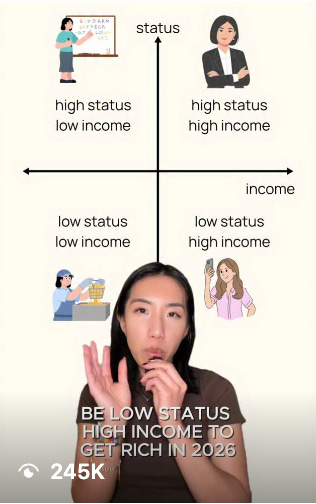
There are people working “prestigious” jobs like doctors, lawyers, and teachers earning £50–70k, burning out, and waiting on their next promotion. And there are people running niche businesses, freelancing, or building audiences earning multiples of that, quietly. No title. No prestige. No external validation. Often earning more than said jobs, and usually more control over their time.
I found this when I transitioned from working in fashion to doing content full-time. The irony was that I was earning more as a creator, but introducing myself as a ‘Junior Account Manager’ somehow garnered more respect than ‘influencer’. Even though it was still a ‘low status’ job, in the sense I was junior, I still feel uncomfortable telling people what I do now. The impression is that I just go to restaurants and pout all day, getting paid thousands to sit at home and chill. The irony is, like anything, it’s a business that requires work 24/7 at the start to get it off the ground, but on the surface it looks effortless.
Worth noting too that status is subjective, and it moves. Creators were not taken seriously even 10 years ago. I was speaking to Patricia Bright recently who said when she left her prestigious job, she didn’t tell anyone. She pretended to still be working there, because the reaction really was ‘so you just put on makeup all day’. Now it's a legitimate career, studies show there’s a growing interest for young kids to become a creator. A 2025 survey of 910 US Gen Alpha kids aged 12-15, conducted by social commerce platform Whop, found that nearly a third want to be YouTubers, while one in five aspire to become TikTok creators (Fast Company). While it doesn't quite hold the prestige of the traditional path yet, but that gap is narrowing faster than most people realise.
I am glad I made this switch because I felt there was potential and opportunity cost. That while I may not even have a regular title, my potential to reach financial freedom seemed all the more within reach.
It’s worth noting that low status jobs are risky, I couldn’t have pursued this without the financial safety net of having a job, a great support network and my emergency fund. But one is a financial risk, the other is a time risk. The time spent almost in a sunk cost fallacy, that ‘ive worked so hard for this prestigious title, i can’t let go’ is time you could spend also building something of your own. The best part is, a lot of these side hustles or ventures can be pursued alongside a full-time job, you don’t have to pick between them.
This brought me back to something Nischa once spoke about that really stayed with me: the difference between the status game and the wealth game. So many people are still optimising for how their life looks to other people, whether that’s through expensive purchases, impressive job titles, or outward signs of success that feel good to show but don’t necessarily create real security.
The wealth game is different. It is far less visible and a lot less instantly gratifying, but it is rooted in things that actually build freedom: saving properly, investing in assets, creating additional income streams, and putting time into your own development so your skills compound over time. What makes Nischa interesting is that she has experienced both worlds. She had the kind of prestigious banking career that naturally gives someone authority, and she still carries the credibility that came with that, but now she operates as a creator.
 Tiktok failed to load.
Enable 3rd party cookies or use another browser
This isn’t about rejecting ambition, or the stability of corporate. It’s about choosing which game you’re playing. The status game optimises for titles, recognition, linear progression, and external validation. The wealth game optimises for ownership, leverage, scalable income, and optionality. Most people chase both, which is fine, but it's crowded. The interesting opportunity sits in the gap: the paths that the status-chasers have already dismissed, leaving the field surprisingly open for anyone willing to trade a title for a head start.
You either look rich or you build it. And increasingly, the people building it don’t look like what we were told success should look like.
If you’re early in your career, this is worth thinking about. Are you optimising for how it looks, or for what it actually pays?
That’s all this week,
Mia xx
This reminds me of a chapter in 'The Psychology of Money' where one of the principles is that wealth is what is what you don't see, like savings accounts and investment portfolios. Career status vs wealth is definitely something for me to think deeply about as a twenty-something.
This resonated with me deeply. I left the fashion industry (as a designer) and moved into corporate consulting, only recently have I realised that one of my main drivers was that I wanted to be "understood" by others. The status, prestige & stability of a corporate career are representative of a "tried and tested", understandable and acceptable career route- one that keeps employees contained in safety. Whereas the possibilities (both financial and creative) with entrepreneurship (freelance, content creation...) are endless in comparison, and yet somehow harder to explain at a dinner party.
What I've come to realise is that the discomfort wasn't really about the career itself, it was about tolerating the gap between where I was/what I was building and what others could immediately recognise as valuable. The wealth game asks you to be okay with that gap, possibly for years. The status game offers a shortcut to external validation that feels like progress but often isn't. Now that I'm building something of my own again, I'm learning to sit with that discomfort rather than run from it, and that feels like the real shift.