


Who you end up with is a financial decision. We don’t like to think about it like that, because money isn’t the most romantic topic, but it’s true. You spend more time with that person than anyone else and at the end of the day, they shape how you spend, how you save and what you think is normal. In a lot of rooms, they’re representing you.
And because money isn’t sexy, the conversation often gets postponed. It waits for a milestone, like moving in together or buying a home, otherwise it never gets scheduled at all. The issue is that one day your partner mentions their savings in passing and you’re hit with shock, in one direction or the other.
Most couples think they’re fine. When Legal & General asked 3,000 people in relationships last year, 86% said they had a healthy approach to talking about money. In the same survey, 17% admitted they avoid the subject altogether. And in a confused.com poll earlier this year, almost half of people said they’d lied to a partner about money, mostly about spending, debt or salary.
That’s money on mute. Everything is fine until the moment it very much isn’t, and by then the sofa, the tenancy and sometimes the mortgage are already joint. So let’s turn the sound back on.
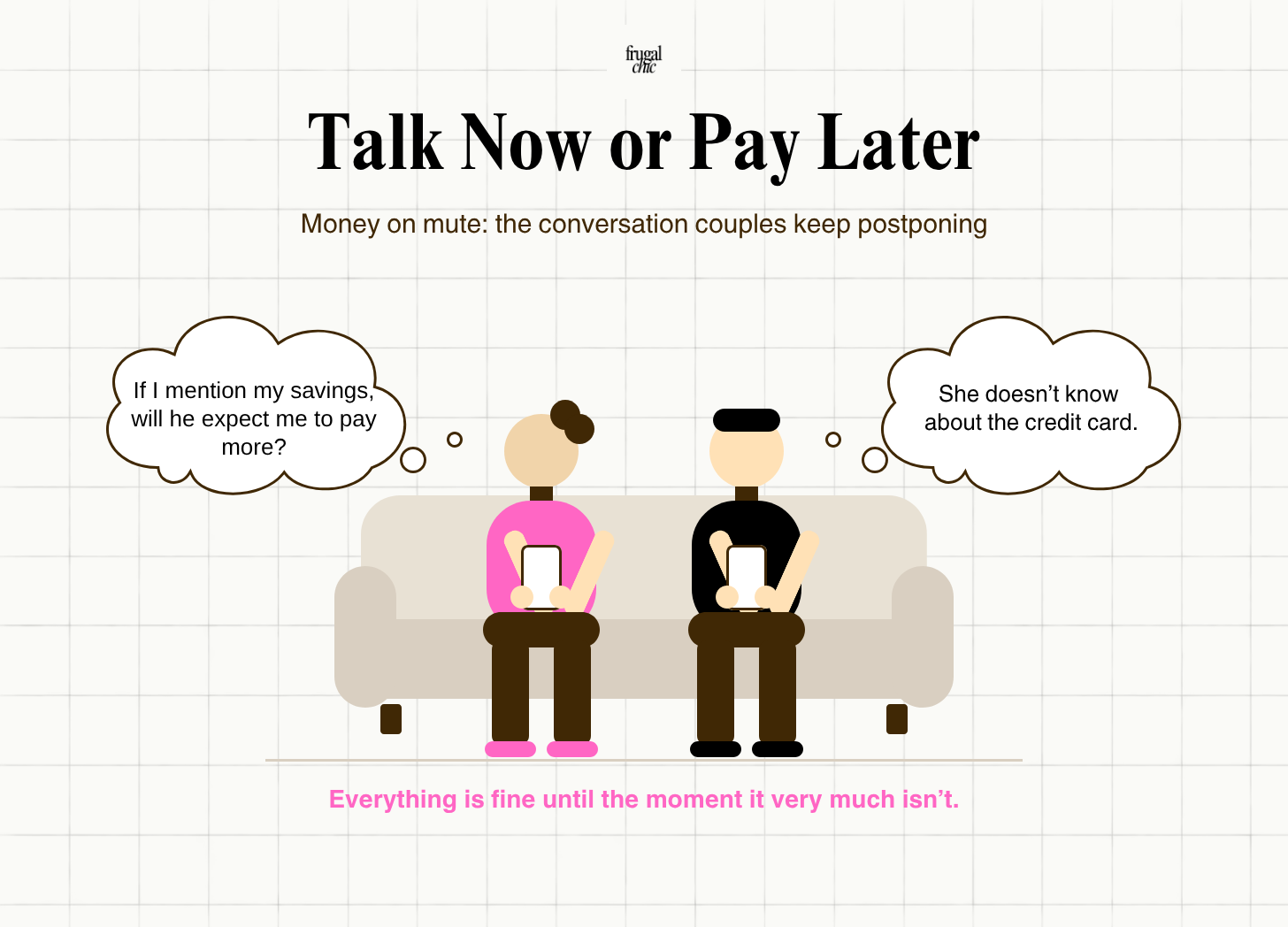
In this issue:
Why “later” is the most expensive word in a relationship
Why I still split everything 50/50 even though I earn more
What fair actually means, including the pink tax
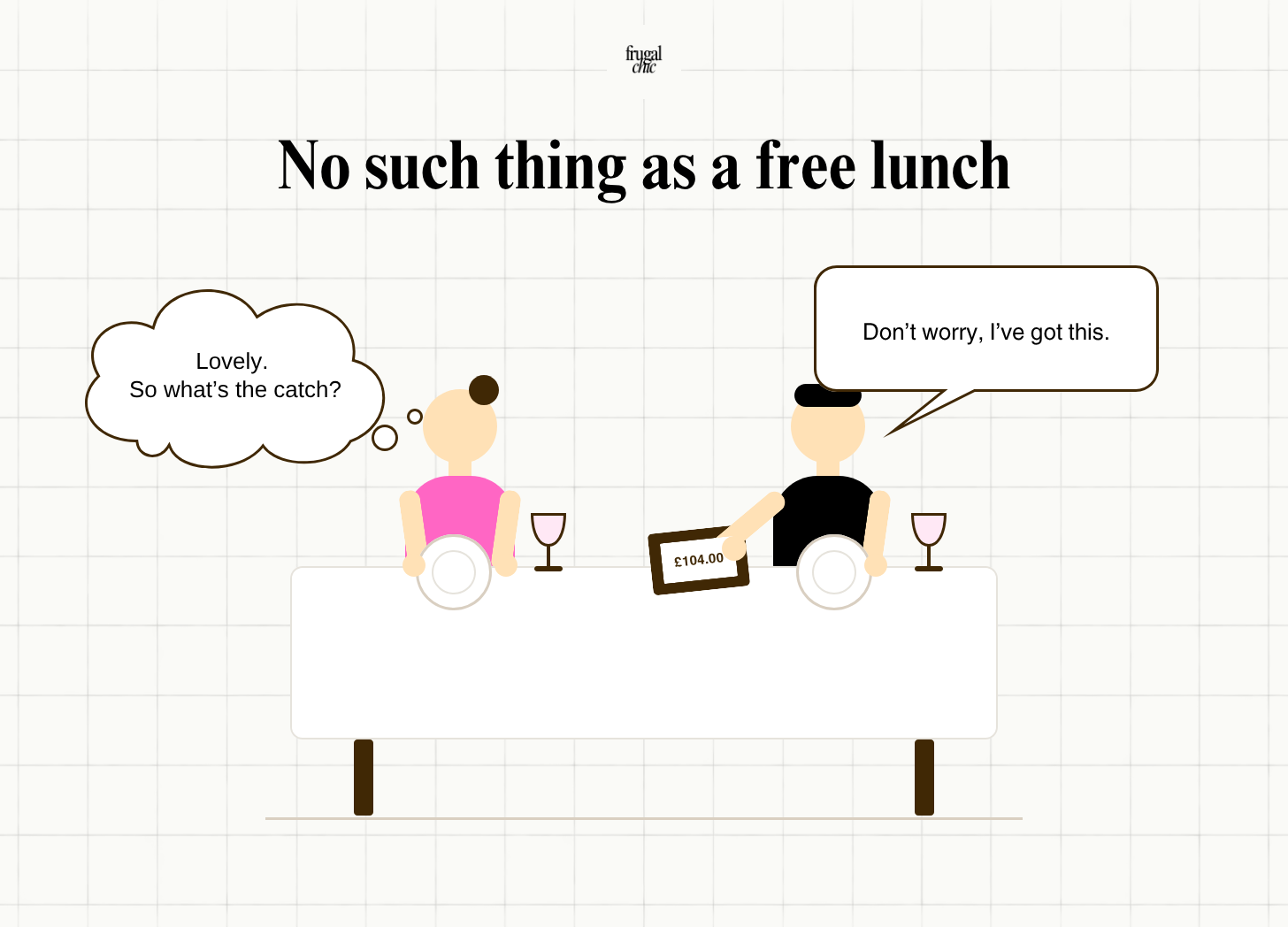
No such thing as a free lunch: the rule I still live by
The five questions to put on the table this week
1. “Later” is the most expensive word in a relationship
Money comes up late because it’s awkward early. By the time it does, you’ve usually already committed to something, so you find things out late. The debt you didn’t know about or the savings that are a fraction of what you assumed, or ten times yours. Two completely different ideas of what “sorted” means.
Is money really the thing that ends relationships? I checked rather than assumed, and the honest answer is: not quite. When Divorce-Online surveyed 500 of its own clients, simply falling out of love came top, with a partner being bad with money second. What the research does agree on is that money is the thing couples argue about most. Royal London found people would rather discuss childcare, sex or household chores with their partner than money.
It’s rarely the amount that does the damage but more so that nobody said anything out loud.
One more thing, because I know a lot of you live with a partner you aren’t married to. There’s no such thing as a common law marriage in England and Wales, however long you’ve been together, even though nearly half of us believe there is. The government only started consulting on changing that this summer. Until it does, the conversation itself is the protection.
The Frugal Chic® rule: Money isn’t the most important thing in a relationship. Being financially aligned is.

2. Why I still split everything 50/50
I made a video recently about why I still split expenses 50/50 with my partner, even though I now earn more than him and it divided people. The more traditional camp thought he should be paying for everything. Another camp thought I should be paying a bigger share.
Here’s the context. I spent over a year building a side hustle alongside a very demanding 9-to-5 in fashion, five days a week in the office. I filmed in the mornings, in the evenings and at weekends, and basically gave up my free time for a year. At the start it made nothing but now it’s my business. Splitting 50/50 is simply what works in my relationship.
But there’s no right or wrong here. For plenty of couples, splitting in proportion to income makes far more sense and feels far more fair. In the same Confused.com poll, 36% of couples split their bills equally and 23% split them in proportion to salary. Both are fine. The only wrong version is the one nobody actually chose and/or felt forced into.
3. What fair actually means
Fair isn’t always monetary, and it isn’t always about salary.
Start with invisible labour. Who does more of the household tasks? Who carries the mental list? If one of you earns a bit more and the other does most of the running of the house, 50/50 on the bills isn’t the whole picture in a relationship.
Then there’s net worth, not just income. Say you’re both on entry-level salaries, but one of you has an inheritance or family money behind you. Splitting 50/50 looks equal on paper. Over the years…it isn’t. That doesn’t automatically mean the person with more should pay more, but it should be the start of a conversation instead of an assumption.
And I’ll say this part to the women reading, because that’s mostly who I’m speaking to. Being a woman is more expensive, and most of the cost is quiet. We end up with smaller pensions: the government’s own figures put the typical private pension for women aged 55 to 59 at £81,000, against £156,000 for men.
We also pay the pink tax on products that are the same thing in a different colour. We pay for safety, like the cab home after a late date that he doesn’t have to think about. Plan International UK found young women spending an average of £44 a month on taxis just to get home safely. Then there’s beauty and fashion, an entire industry marketed at us.
None of that is an excuse for men to pay for everything. However, it’s an argument for putting all of it on the table when you work out what fair looks like for the two of you.
4. No such thing as a free lunch
When I was growing up, my parents always said there’s no such thing as a free lunch.They meant that nothing in life is ever truly free.
Not that everything is a transaction, or that generosity always has strings. But if someone pays for your entire meal and all of your drinks, there’s a chance they expect something back: that you’ll be nice about it, that you’ll come for one more after. And as a woman who thinks about safety, I don’t think having someone pay for your entire existence is very safe.
Paying your own way is incredibly empowering. It means you’re never obligated to go along with something you’re not happy with, not that you would be anyway. I’ve said this on TikTok before and I’ll keep saying it: you need to have your own money. If you meet someone who earns more than you, that’s a bonus.
It’s also why I’m wary of the hypergamy and tradwife content everywhere right now. That’s not to say there’s anything wrong with one partner staying at home, or with a partner being generous because there isn’t. The tricky part is relying solely on someone else for income, however much you love them. Surviving Economic Abuse found one in seven UK women had experienced economic abuse from a partner or ex in a single year, and nearly a quarter of them said it stopped them from leaving.
For me this isn’t really about relationships at all. It’s about not being too dependent on anything. I moved out of my parents’ home when I didn’t have to, and they weren’t charging me rent. I wanted to pay my own way and understand my own expenses, and I grew up a lot faster for it.
5. The five questions to put on the table
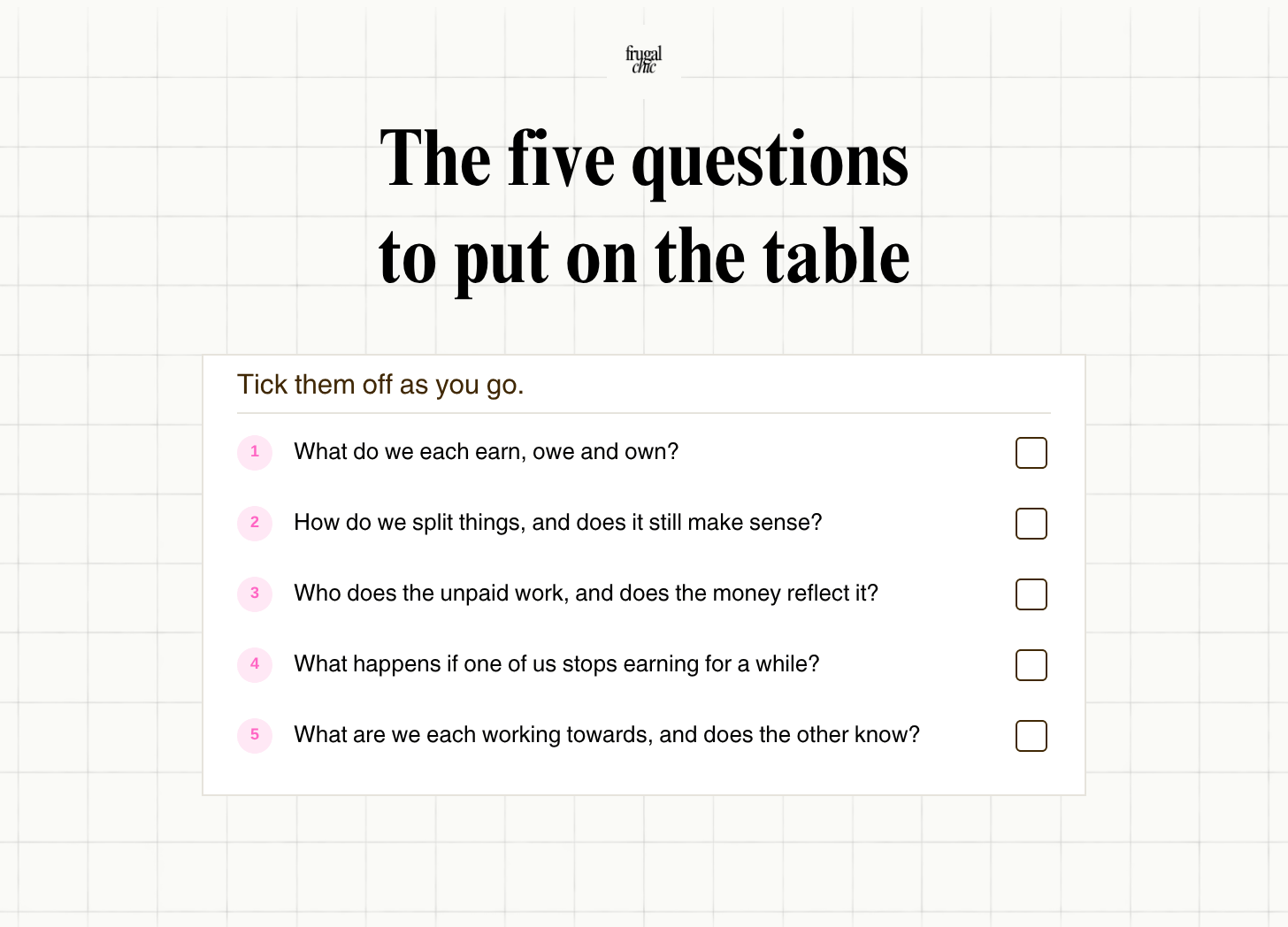
The most important thing isn’t which system you pick. It’s that you picked it, together, out loud. If you’ve never had the conversation, this is where I’d start:
What do we each earn, owe and own? The whole picture, including the bits that feel awkward.
How do we split things, and does that split still make sense?
Who does the unpaid work, and does the money reflect it?
What happens if one of us stops earning for a while?
What are we each working towards, and does the other one know?
Nobody enjoys this conversation the first time. The second one is easier, and by the third it’s just a chat you have periodically.
This week, do one thing
Think about it and pick one question from the list but don’t lead with the one that feels like it’s the most difficult. Ask it this week, somewhere relaxed, and let the answer be whatever it is. You’re not negotiating anything yet, you’re just turning the sound back on.
The key takeaway here is: who you end up with is a financial decision, so make it with your eyes open and the sound on. Money isn’t the most important thing in a relationship, but being financially aligned is, and you can’t be aligned with someone you’ve never actually talked to about it.
That’s all this week,
Mia xx
P.S. Every one of those five questions is an ask, and asking is a skill most of us were never taught. On Wednesday, paid subscribers get the high agency breakdown: why being willing to ask, push back and go first is the highest-return thing you own, and the specific asks that pay better than any fund. I can’t wait to share it all with you.
Very helpful
this really resonated, thank you for sharing it so simply. i do believe there is always a cost to putting off a conversation, especially in our relationships. i also very much agree a woman should always have her own money, and it doesn't always need to mean leaving the house to make it or that your relationship is doomed to fail. from my perspective, it's being realistic and another way of taking care of myself.