


“I don’t want to be rich, I want to be free. But in order to be free, I have to be rich.”
This is a quote I heard fellow creator Erin Confortini say in a video, and I’ve been obsessed with it ever since. It perfectly encapsulates how I feel about wealth.
Growing up, I always aspired to be rich. Perhaps when I was younger, it was the glossy luxury I pictured: a high-rise flat, a handbag dog, and a walk-in wardrobe. Over time, it evolved. As I realised the value of money, or rather how much of my life had to be traded in exchange for it, I became less focused on the outward projection of wealth and more focused on how it made me feel inside.
It wasn’t necessarily the state of having a lot of money that I was hoping for. It was the increase in time, choice, and autonomy.
Now, at 25, I am much closer to my financial goals than I could have realised.
I have a solid emergency fund and, being self-employed, have set up accounts such as a private pension.
I’ve built a £100k+ investment portfolio.
A £400k+ company.
That was a far-distant reality for the 18-year-old starting out with £0 and no clue what she was doing.
Over time, I’ve noticed that each little milestone has unlocked a bit of financial freedom for me.
In this issue:
Why financial freedom is not one single destination
How to recognise the earlier stages of freedom before you reach full financial independence
Why “enough” matters more than endlessly chasing bigger numbers
The role of emergency funds, investing, Coast FI, and work-optional wealth
Why every level of financial freedom gives you more choice, not just more money
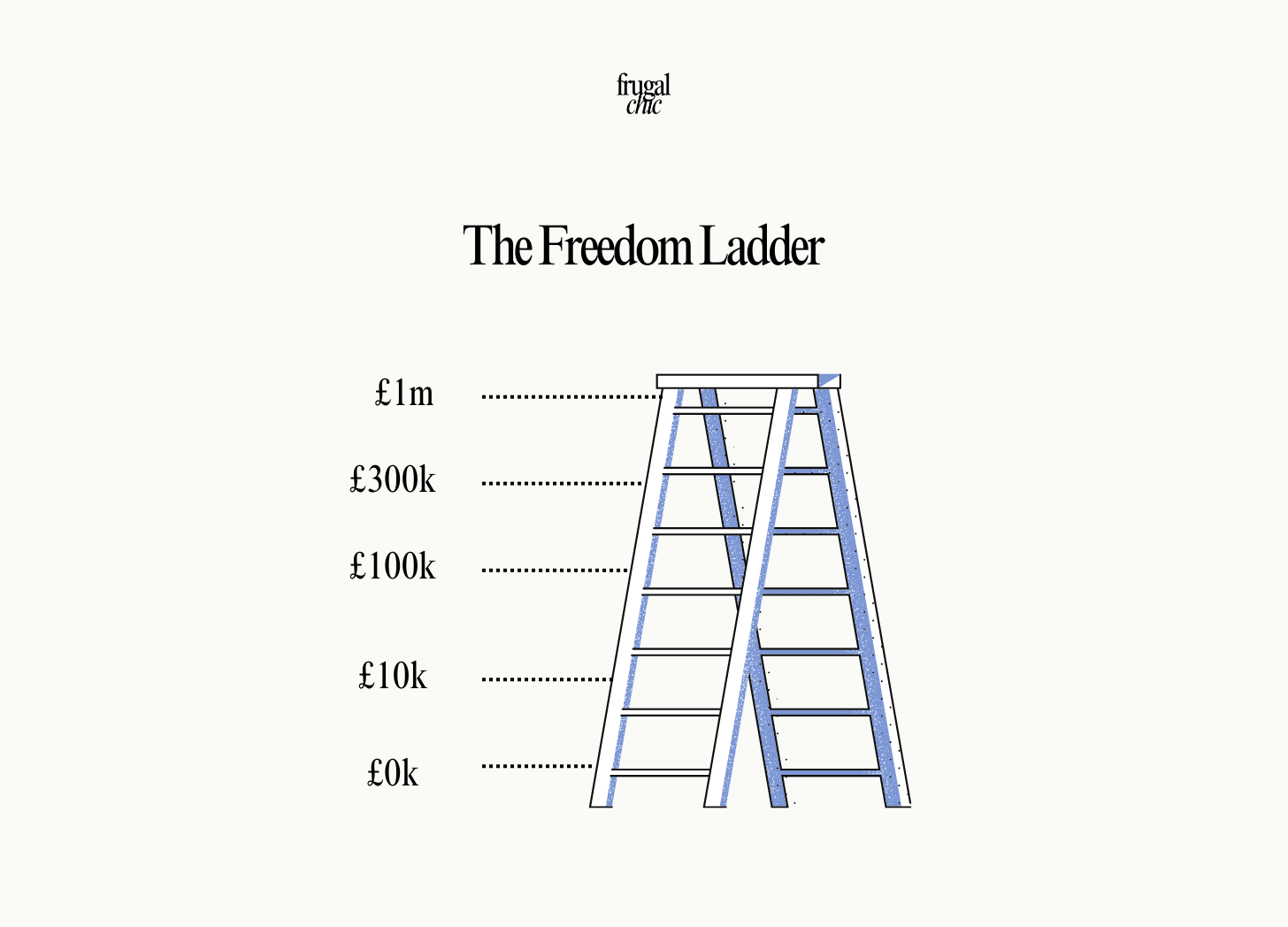
For most of us, we often speak about financial freedom in terms of reaching a huge, lofty number, such as £1 million. Phrases like “I want to be rich” and “One day, when I win the lottery, I’ll do X” hint that it is often used as shorthand for a better life, yet the specifics are rarely made explicit.
For some, freedom means the ability to do meaningful work rather than simply well-paid work. For others, it means spending time with friends and family without mentally calculating the cost of every decision. It may mean living in a safe area, having time to rest, or moving through the day without the constant pressure to monetise every spare hour.
This is part of the problem. Financial freedom is often discussed as though it were a distant and abstract ideal, reserved for people who are already privileged. But in reality, it’s not a one-size-fits-all idea, and it doesn’t appear all at once. In fact, you cross many different stages of financial freedom in life, which I call the Freedom Ladder.
The Freedom Ladder
There are milestones along the way that unlock varying levels of financial freedom.
Defining enough
The first is conceptual. It is the shift from assuming that freedom requires endless accumulation to recognising that it begins with defining what is enough. If your desires are permanently increasing, no level of income will ever satisfy you. But if you are clear on what makes a good life for you, rather than what looks impressive to other people, you need far less money to feel settled, complete, and in control.
Having a buffer
The second level is protective. This is where a cash buffer, or what I call a cushion fund, begins to change your relationship with work and risk. A healthy emergency fund gives you the ability to leave situations that are harmful, unstable, or simply no longer right for you.
That may be a job, a relationship, a living arrangement, or a period of financial chaos. The ability to walk away is one of the earliest and most important forms of freedom money can buy.
It also gives you protection if you lose your job through redundancy or another circumstance and have to find a new one, as it reduces the urgency to take any new job you can get.
Building momentum
The third level is momentum. For many people, reaching six figures in invested assets marks a significant psychological and financial turning point. At this stage, investment growth begins to feel more visible.
The market’s movements, for better or worse, start to have a noticeable effect on your portfolio, and the mathematics of compounding become easier to believe because you can see them happening in real time.
Your money is no longer growing only because of what you add to it each month. Increasingly, it begins to generate growth on its own.
Benjamin Franklin famously wrote that “money makes money”, and while the phrase is simplistic, the principle is sound. Capital, once accumulated, has the capacity to reproduce itself.
Coast FI
The fourth level is what many now call Coast FI. This is the point at which, even if you never invested another pound, the money you have already built would still be enough, given time and compound growth, to support you later in life.
Coast FI matters because it changes the function of your labour. You no longer work primarily to secure your distant future. That future has, in large part, already been funded.
Work can then become about covering present-day living costs, exploring different priorities, or simply reducing the intensity of the race.
Work-optional status
The fifth level is full work-optional status, often associated with a financial independence number, which we’ll discuss shortly. This is the point at which your assets can sustain your lifestyle indefinitely, or at least for the foreseeable future, without requiring employment income.
It does not necessarily mean retiring in the traditional sense. It means choice. You can continue working if you want to, but not because you have no alternative.
Freedom arrives in stages
This is why it is so limiting to imagine that freedom begins only at a net worth of £1 million.
In reality, most people encounter meaningful forms of financial freedom much earlier than that. They experience it when they build savings that allow them to leave a situation, or when their investments begin to carry part of the load.
Freedom does not suddenly arrive one morning in its final form. You pass through varying degrees of it along the way.
Every level I have passed, I’ve gained slightly more confidence which actually changed the way I moved through the world.
I think this is true for so many of us in the personal finance creator space. The goal usually isn't luxury for the sake of it... it's freedom. Freedom from needing an employer, freedom from someone else controlling your time and what you can and cannot do through the week.
Meanwhile, I see Chanel bags and Cartier bracelets all over Instagram from people whose net pay I know... and it always reminds me how different people's financial priorities can be.
I've been writing a lot about this exact mindset on my page too so if that resonates with you, I'd love for you to check it out :)
Very interesting. I will definetly be thinking about how to adapt all levels to myself and what do they mean to me. Thank you.