


Most of us know the familiar feeling of scrolling online, seeing someone who looks absolutely stunning and wondering how they look like that.
What skincare do they use?
What makeup are they wearing?
Where did they buy that outfit?
We start looking for the exact products they use, hoping that buying the same things will help us replicate the same result.
Sometimes this comes from genuine inspiration. You see an outfit you love, buy something similar and wear it for years.
But sometimes it comes from insecurity.
Those tend to be the purchases that end up collecting dust. They are the products we buy and barely use, or the clothes that look great on someone else but never quite feel like us.
Then comes the buyer’s remorse.
Did I actually need that?
Did I even want it?
I call this the insecurity tax.
In this issue:
How you’re quietly paying more for your insecurities
Beauty as a survival mechanism
My relationship with insecurity and confidence
How to reduce your insecurity tax bill
I grew up Chinese in the UK in the early 2000s.
The beauty standard at the time was incredibly Eurocentric. Think blonde hair, blue eyes, a button nose and the Barbie type of beauty you saw in films, magazines and on Disney Channel.
I looked nothing like that.
I was also the only Chinese child in my school. Kids would pull the skin around their eyes, make racist jokes and ask whether I could see properly. At that age, you don’t always understand how much your environment is shaping the way you see yourself.
You just start to believe there is something wrong with you.
I remember pinching my nose and wishing it looked different. I watched makeup tutorials designed for features I didn’t have. I even ordered double-eyelid tape online because I thought changing my eyes would make me prettier.
It sounds disturbing when I write it now, but when you are young, you don’t realise how deeply the world around you can influence your self-image.
For years, caring too much about my appearance kept me trapped financially, mentally and emotionally.
I spent money trying to become a better version of myself, without realising that the version I was chasing didn’t actually exist.
I was paying the Insecurity Tax.
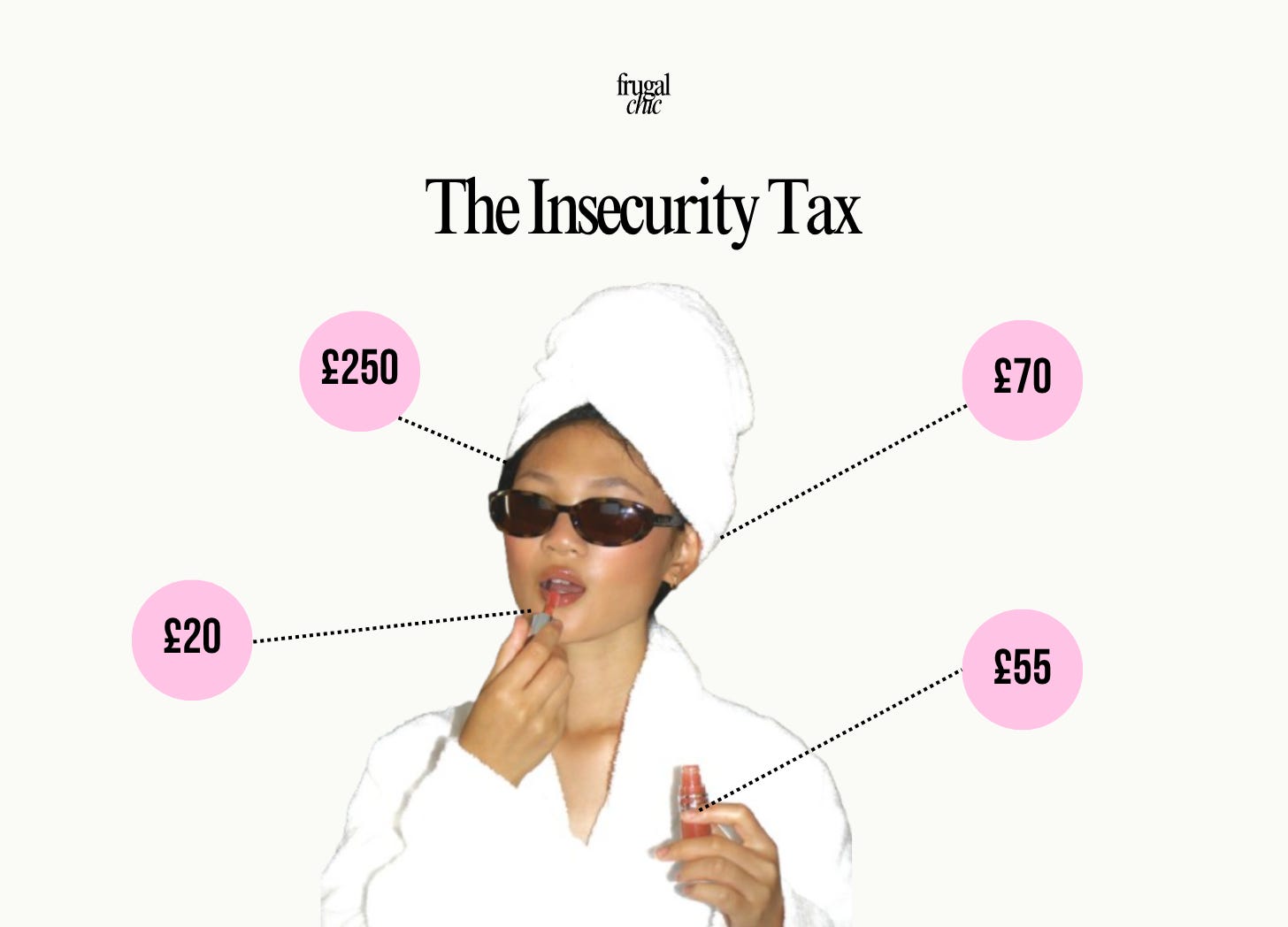
It is the money you spend trying to fix something about yourself that may never have needed fixing in the first place.
It can show up as clothes, makeup, skincare, cosmetic treatments, hair appointments, supplements or anything else sold to us with the quiet promise that we will finally feel good enough afterwards.
The problem is, insecurity is extremely profitable.
There will always be another product, another treatment, another trend or another version of yourself to pursue.
The Insecurity Tax does not just cost you money. It keeps you trapped in the belief that more is always better and that you are always one purchase away from being complete.
Beauty as a survival mechanism
Women already face a lot of additional costs.
Periods, the pink tax and the wider financial impact of the gender pay gap are the obvious examples.
On top of this, women are constantly taught that beauty equals success.
We know attractive people can benefit from the halo effect, where people assume someone has other positive qualities simply because they are physically attractive.
Women who wear makeup can also be perceived as more polished or professional in certain workplaces.
We can pretend appearance doesn’t matter, but that would be dishonest.
There are real social and professional incentives attached to looking a certain way, particularly for women.
This is why beauty can start to feel less like a personal choice and more like a survival mechanism.
I am not saying that spending money on beauty automatically means you are insecure. I still wear makeup. I like clothes. I enjoy looking presentable.
The difference is whether you are buying something because you genuinely value it, or because you believe you need it to become more worthy.
For a long time, I struggled to tell the difference.
Becoming attractive didn’t make me confident
You could argue that I have had a glow-up.
I became a model for several years. My appearance changed. I learned what suited me and became better at styling myself.
Strangely, though, my confidence did not improve when I became more conventionally attractive.
It improved when I stopped treating my appearance as the most important thing about me.
At 25, I can leave the house without makeup. If someone takes an awful photo of me, I genuinely do not care.
Ten years ago, an unflattering photo could ruin my entire day.
I was constantly monitoring myself through other people’s eyes. I would think about how I looked while I was talking, sitting, laughing or simply existing.
There is a strange irony in spending so much time worrying about your appearance that you are barely present in your own life.
My confidence changed when I stopped trying to build my identity around how I looked.
I found something else to care about
One of the biggest shifts happened when I discovered personal finance and investing.
I went down a complete rabbit hole.
I would come home and binge-watch videos about investing, dividend stocks, compound interest and the FIRE movement, which stands for financial independence, retire early.
The idea of becoming work-optional fascinated me.
I learned about the significance of building your first £100,000 and how compound growth becomes more powerful as your investments increase.
For around seven years, reaching that number became one of my biggest goals.
It gave me something else to focus on.
Instead of spending money trying to improve my appearance, I became interested in building an investment portfolio and creating more freedom for my future.
Personal finance was the interest that helped me redirect my attention, but yours could be completely different.
It could be writing, fitness, films, gaming, pottery, history, business or learning a language.
The point is to develop parts of your identity that have nothing to do with how attractive you are.
When your appearance is your main source of value, every bad photo, breakout or change in your body can feel like a crisis.
When you have skills, hobbies, ambitions and interests outside of it, appearance becomes one small part of a much bigger life.
Content creation forced me to stop being perfect
Another shift happened when I started creating content.
Short-form content requires consistency. When I was starting out, I would post up to three times a day while still working my nine-to-five.
I didn’t have time to make everything look perfect.
Sometimes the lighting was bad. Sometimes I had a pimple. Sometimes I looked exhausted.
I posted anyway.
Creating content forced me to show up on days when I didn’t feel attractive. It also got me used to how I actually looked when I spoke and moved, rather than the carefully selected version of myself I saw in selfies.
Ten years ago, I would have been too distracted by how my face looked when the camera flipped to focus on what I was actually saying.
Eventually, I had to make a decision.
I could either spend my time worrying about my appearance, or I could use that time to build something.
I chose the second option.
That does not mean I never think about how I look. It means I no longer allow it to take up the majority of my mental space.
The Frugal Chic approach to beauty
This shift also shaped my wider Frugal Chic philosophy.
Splurge on what you love and cut back on what you don’t.
I like spending money on experiences, education, comfort and anything that genuinely improves my quality of life.
I am happy to do the bare minimum with parts of my appearance that do not matter much to me.
I don’t get my nails done. Not because I think manicures are pointless or don’t look nice, but because I don’t enjoy the time commitment.
I get my hair cut around every six months. I use largely the same skincare and makeup products every day.
At one point, I was washing my hair with shampoo I had taken from a hotel.
To some people, this probably sounds completely normal.
But in an era where constant modification is becoming normalised, being content with looking like yourself can start to feel almost radical.
I am not trying to optimise every inch of myself.
I would rather build skills, financial security and a body of work that is not dependent on me remaining young or attractive forever.
Pretty privilege
I have spoken about wanting to decentre my appearance on YouTube and in short-form content. The most common backlash is: “Well, it’s easy for you to say. You’re young and incredibly beautiful.”
Even though I think beauty is subjective, I can hear this.
I have straight hair, clear skin and a naturally small frame, all things that many women spend a lot of time, money and even pain trying to achieve.
But we also cannot erase how I felt growing up, or the fact that I did not fit the beauty standard at the time. There is far more diversity and representation in the media now, largely thanks to social media, which has democratised fame and success for many women of colour.
Not only that, just because I am 25 does not mean I am not allowed to have a perspective on beauty, insecurity or the way women are taught to relate to their appearance. I hope that my future 40 or 60 year old self will feel confident too, but they’re right - life will throw new challenges at me.
I also understand that not fitting the standard at all, having severe acne or dealing with a visible condition can make it much harder to simply “forget about your appearance”.
Presented as a blanket statement, the idea of decentring appearance can sound ableist, dismissive or ignorant.
But, as with all of my content, I can only speak from my own lived experience.
My “bare minimum” will also look different from someone else’s.
For one person, it might include getting their eyebrows threaded, having a blow-dry or getting a manicure and pedicure. That’s what they need to feel they look presentable.
Everyone has a different definition of ‘enough’.
Getting braces, having surgery recommended by a doctor, treating a skin condition or making a change that genuinely improves your quality of life are all completely valid.
I am not against beauty, maintenance or changing something about yourself.
I am against beauty-maxxing culture designed to keep women on a treadmill, constantly chasing a new flaw, a new treatment and a new version of themselves that is always just out of reach.
How to reduce your insecurity tax bill
Curate your feed carefully
I used to follow a lot of influencers and models simply because I thought they were beautiful.
My Instagram Explore page became a never-ending stream of perfect faces.
I told myself it was inspiration. In reality, it mostly made me compare myself and feel worse.
If someone’s content consistently makes you feel inadequate, unfollowing them could genuinely help.
Your feed is an environment, and environments shape how you think.
This applies offline too.
I have had friendships where every meetup seemed to revolve around taking photos. There is nothing wrong with enjoying pictures, especially when you work in content, but there is a difference between documenting your life and living primarily for documentation.
Other people’s insecurity can rub off on you.
Choose people who make you forget about how you look.
Build interests outside your appearance
Find something you enjoy that has nothing to do with beauty.
For me, that became personal finance, investing and content creation.
I also love films. I rate everything on Letterboxd. I play games on my Nintendo Switch and have spent an unreasonable amount of time playing Two Point Hospital.
None of those interests make me prettier.
That is the point.
You need parts of your identity that still exist when you are not dressed up, wearing makeup or feeling your best.
Buy less
Buying less changed my relationship with my appearance.
I started experimenting with low-buy and no-buy periods because they forced me to become more selective.
This year, I have been doing a challenge where I only buy one fashion item per month.
It has made me think much more carefully about what my wardrobe genuinely needs.
When you consume unconsciously, you can start sending yourself the message that you are not enough without those things.
You need another outfit to feel stylish.
Another product to feel beautiful.
Another treatment to feel confident.
Buying less can become a way of proving to yourself that you are already complete.
It also saves money, which is a fairly convenient side effect.
Decentre male approval
I also became more conscious of how much of my appearance was shaped around attracting male approval.
When I was younger, I wore more bodycon and traditionally flattering clothes because I believed that was what made me attractive.
Now, I dress much more for myself.
Or, arguably, for the female gaze.
If my boyfriend hates an outfit, I usually assume I am doing something right.
But dressing for yourself rather than trying to predict what other people find attractive can be incredibly freeing.
My style may look boring or overly capsule-wardrobe to some people, but I know what I like.
That clarity is more valuable to me than being universally appealing.
The real glow-up
You cannot simply wake up one morning, decide to decentre your appearance and suddenly feel completely confident.
But you can begin reducing the amount of power it holds over you.
You can invest more time in your brain, your skills, your interests and the life you are building.
That is how you develop real taste.
That is how you build a life that actually feels like yours.
At 25, something I wish I could tell my 18-year-old self is:
“Your appearance is the least interesting thing about you”.
That’s all this week,
Mia xx
I resonate with this! I’m Canadian born with Filipino and Ghanaian heritage and spent part of my childhood living in the Philippines. Being the only black girl with curly hair and black features made me insecure about my looks. I found that embracing your individual beauty and uniqueness outside of beauty is the way to go!
Love this, I was always thought this going into corporate jobs and the men pretty much all wore a similar suit and shirt. While the women were juggling all sorts of professional outfits, heels and makeup. Maybe we were doing it to ourselves but what you wrote resonated with me!