


“Earn with your mind, not your time.” Naval Ravikant
For years, I believed the key to growing wealth was to do two things simultaneously: live below your means and increase your income.
Yes, while those two methods are the bedrock of personal finance, they help build stability and may even get you ahead financially, they aren’t the only factors necessary.
What I didn’t realise early on is that those two behaviours alone have a ceiling. They protect you from chaos, but they don’t automatically move you into the higher stages of what I think of as the Frugal Chic ® Pyramid of Wealth. To get there, you have to go beyond discipline and effort.
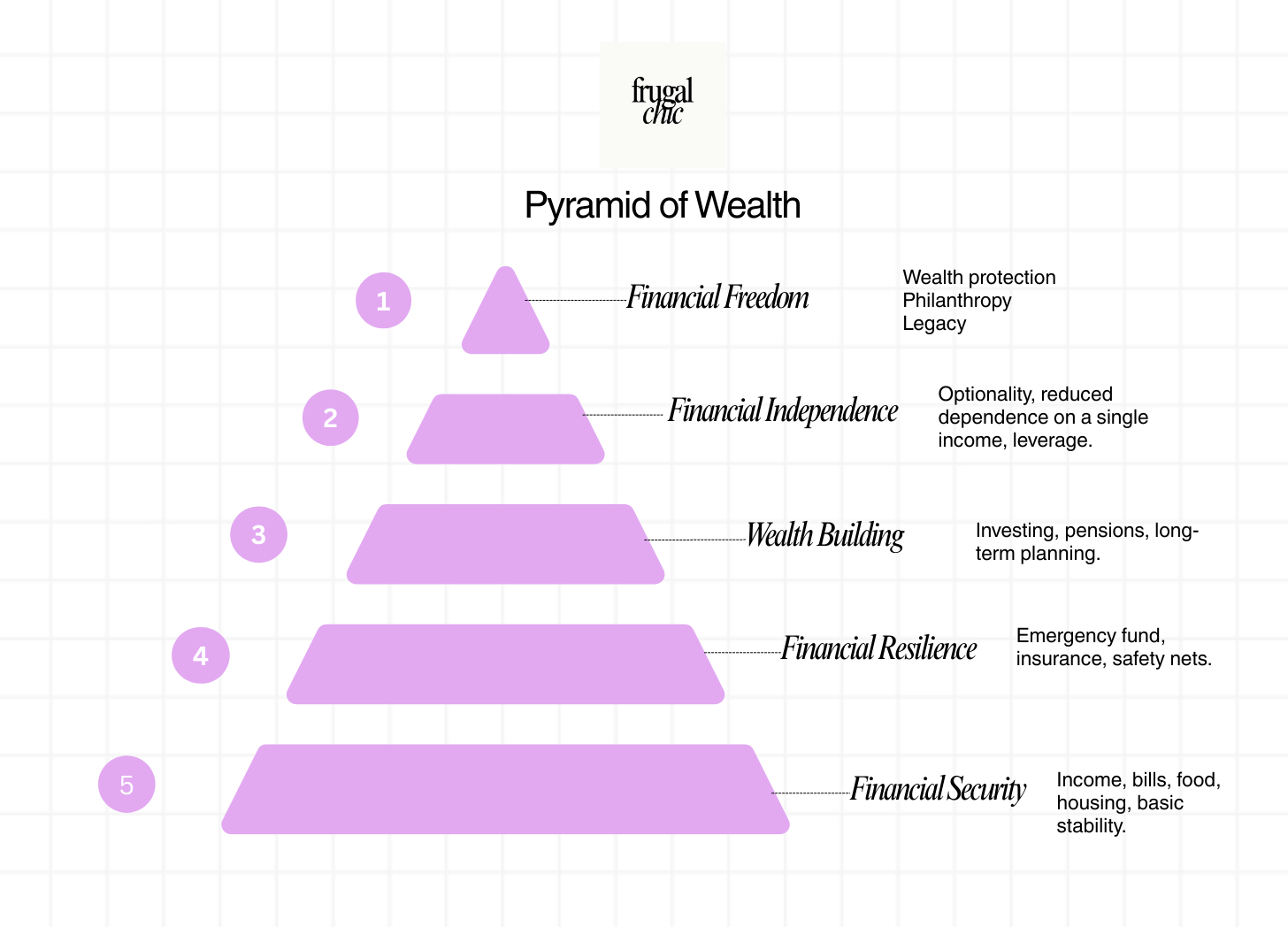
Growing up, we’re taught that working harder is the path to getting rich. The problem is, the rich don’t work harder, they work smarter, using resources and systems built over time. I’m not talking about nepo babies or inherited fortunes, but the growing class of so-called “everyday millionaires” being created quietly each year. According to the UBS Global Wealth Report, these everyday millionaires, defined as people with $1–$5 million in assets, have quadrupled in number since 2000, now totalling around 52 million globally. These people did not make their millions by not buying the £5 latte or trading an extra hour for £12, they used leverage.
A year ago, I thought I was doing everything right. I saved aggressively. I worked mornings, evenings and weekends to increase my income. But there came a point where I’d come home from my nine to five, open my phone, and start filming content immediately. My childhood bedroom was dark by the time I got back. A £5 clip-on light from TikTok Shop cast an unflattering glow across my face. My stomach was grumbling for dinner. The time crept onto 7 then 8pm. That’s when it clicked. This wasn’t something I could sustain forever.
You can only cut expenses so far before your life becomes joyless and you can only trade hours for money before time itself becomes the limit. I needed leverage.
What Leverage Actually Means
Leverage is a term that is often misunderstood or poorly explained. Growing up, I only ever heard it in contexts that made it sound risky, unethical, or reserved for people in finance. It was never framed as something ordinary people could, or should, use.
In reality, leverage is simple.
It is getting more output from the same input.
I truly believe that concepts like compound interest, leverage, and dividends don’t really mean anything until you witness them in your own life. You can read a finance textbook from front to back, but until you put the principles into practice and see the results with your own eyes, they don’t carry any emotional weight.
That’s exactly what happened to me with leverage. I knew what it meant. I knew it was important. However, it didn’t really click until much later.
When I look back, the real change in my financial life didn’t come from saving an extra fifty pounds a month. It came from learning how to stack different forms of leverage deliberately, often quietly, and usually without immediate reward. I was already doing it unconsciously through investing, posting content, and selling digital products, but it wasn’t until I’d put in hours and hours of effort that I started to see the benefits of delayed gratification.
I didn’t realise it at the time, but by posting content consistently, I was building two forms of leverage without meaning to: trust and media. By showing up repeatedly, explaining things clearly, and being transparent about my own journey, I was building an audience.
This is something that simply wasn’t possible until very recently. For most of history, reach was controlled by large institutions or gatekeepers. Today, a 20-year-old with a phone can have the same distribution power as a legacy organisation or public figure.
I recently watched one of Sumi’s film recommendations: Scorsese’s The King of Comedy, where De Niro plays an aspiring stand-up comedian. Frustrated by his lack of success and forced to wait for gatekeepers to even listen to his tape, he eventually takes desperate measures. It was very funny, I highly recommend. It’s a reminder that in the 1980s, fame was tightly guarded by institutions. That isn’t the case anymore.
Leverage breaks the direct link between effort and outcome. It allows work done once to keep producing results long after the initial effort, and to reach far beyond what’s possible through one-to-one effort.
There are a few forms of leverage that matter most.
