


This is a touchy subject, but it’s a necessary one.
Any time you talk about growing wealth online, there are always anonymous comments like:
“this is only possible if you have rich parents”
Or
“you can only do this if you’re pretty btw.”
Today I want to talk about how envy and comparison don’t protect you or keep you realistic, they keep you exactly where you are.
How I Used Appearance as an Excuse
For half of my life, I genuinely felt ugly. I’m 25 now, and yes, I model, and yes, I get hundreds of people telling me I’m pretty online. But if you’d told 12-year-old me that, she wouldn’t have believed you for a second.
Growing up as a Chinese adoptee in the early 2000s, I was teased for my eyes, kids would pull their eyes to mock mine and I was asked if I could see ok. Everyone deals with some level of this at school, but being the only Chinese kid in my classes and never seeing anyone who looked like me in the media made it clear this wasn’t just insecurity. It was systemic.
Thankfully the world looks very different now. Diversity is celebrated, and I genuinely love my Asian features. But when people say the only reason I’ve built a successful personal brand in personal finance is because of how I look, it erases the effort I put into building something deliberately not tied to my appearance.
It’s also deeply ironic, because I grew up believing I’d have to work ten times harder to be seen as attractive compared to a white counterpart. I can now recognise that society treats me as conventionally attractive, but I never expected to benefit from “pretty privilege.”
What’s more interesting is this: I used to use the same excuse myself.
I tried social media years ago. When it didn’t work, I told myself it was because I wasn’t pretty enough. That story felt safer than confronting the reality that maybe I hadn’t built anything yet.
That belief didn’t protect me. It stalled my growth.

The Aesthetic Gap Excuse
At university, I watched peers become influencers with ease. They had space. Beautiful homes. Parents who funded the aesthetic before the income existed.
There was one girl in particular I was envious of. I already knew she had rich parents from what she shared online. Walk-in wardrobe. Annual trips to America. Endless clothing hauls.
At the time, I convinced myself it wouldn’t be possible for me. I didn’t have the aesthetic background. I was living at home on a £13k intern wage, still in my childhood bedroom. Yes, that was a privilege in itself, but I remember constantly thinking how much easier it would be if I had rich parents, a beautiful home, or if I were blonde and white.
Those thoughts became excuses. And those excuses became inaction. I was more preoccupied with lurking on their Instagrams than actually getting up and building something for myself.
Now I realise, it’s easier to watch and criticise than it is to create.
The Excuse I Regret Saying Out Loud
Around the same time, a family friend who did come from a rich family had built a business in his late teens reselling Rolexes and fancy cars. I remember saying directly to him, “well that’s only possible because your parents gave you the money.”
I cringe thinking about that now.
While it’s valid to acknowledge an advantage, I wouldn’t say that today. Years later, when I reflected on it, I realised something uncomfortable. Yes, having the comfort of being at home, which I had too, and having parents who were financially fluent in investments and business. But the business itself wasn’t complex at all.
My envy and comparison led me to decide it wasn’t possible for me, and therefore I didn’t try.
Did I actually want to resell watches? No. Did I possess the same skillset or drive? No. So why did it bother me so much that someone else had done it?
Because it challenged my belief that working for yourself at a young age was possible. It challenged the idea that the “traditional” route, going to uni, racking up £50k in debt, and starting out as an admin assistant for a few years, was the only sensible option.
When I really sat with it, I realised I wasn’t jealous of the business model. I was jealous of the success - of the fact that I hadn’t done that for myself.
That’s why I empathise so much with the comments I get saying, “it’s not possible for me.” Because that voice was once my own.
But the uncomfortable truth is this: those excuses kept me stuck exactly where I was. Not trying, and always looking for something to blame for a lack of success.
When you tell yourself something isn’t possible for you, your brain stops looking for evidence that it is. Over time, that story becomes your reality. That’s how excuses keep you broke.
What Actually Changed Everything
Now, as someone who pays rent in Zone 2, makes six figures a year, and works for herself, it genuinely wouldn’t occur to me to think like that anymore. Not because the world suddenly became fair, but because I stopped outsourcing responsibility for my life. I actually realised I had many privileges in life that I wasn’t using because I was too focused on pocket watching others.
Once I started building something of my own, I realised the amount of work that was required. I now have respect for anyone willing to put themselves out there or build their own business, even if they had a ‘leg up’.
Yes, some people have unfair advantages. Parents, money, looks, luck. That has always been true and it always will be. But spending your energy cataloguing other people’s advantages doesn’t move you an inch closer to your own version of success.
At some point, you either keep watching, comparing, and blaming, or you start playing the game with the cards you’ve been dealt.
You might not have financial backing, but maybe you have time, intelligence, grit, or curiosity. You might not have the aesthetic, but you have something else the algorithm can’t manufacture: perspective.
If I’d stayed convinced I wasn’t attractive enough or rich enough to start, the price wouldn’t have been insecurity, it would’ve been lost compounding. Time spent pocket-watching or delaying is time not spent building skills, testing ideas, charging properly, or creating something that compounds.
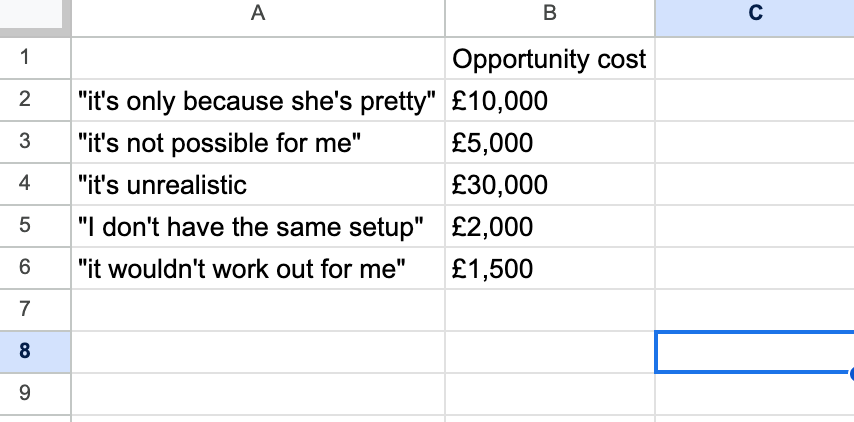
When you tell yourself something isn’t possible for you, your brain stops looking for evidence that it is. You don’t try, experiment or build. Over time, that story stops being a thought and becomes an identity.
And that’s why the most expensive habit is making excuses.
That’s all this week,

Love this insight and reality check. Thank you
Thank you Mia for being so brave and sharing so honestly