


You did everything right. You worked the long hours, you earned the pay rise, you grew the following or you built the business. And somewhere along the way, someone said it.
“You’ve changed.”
Not as a compliment.
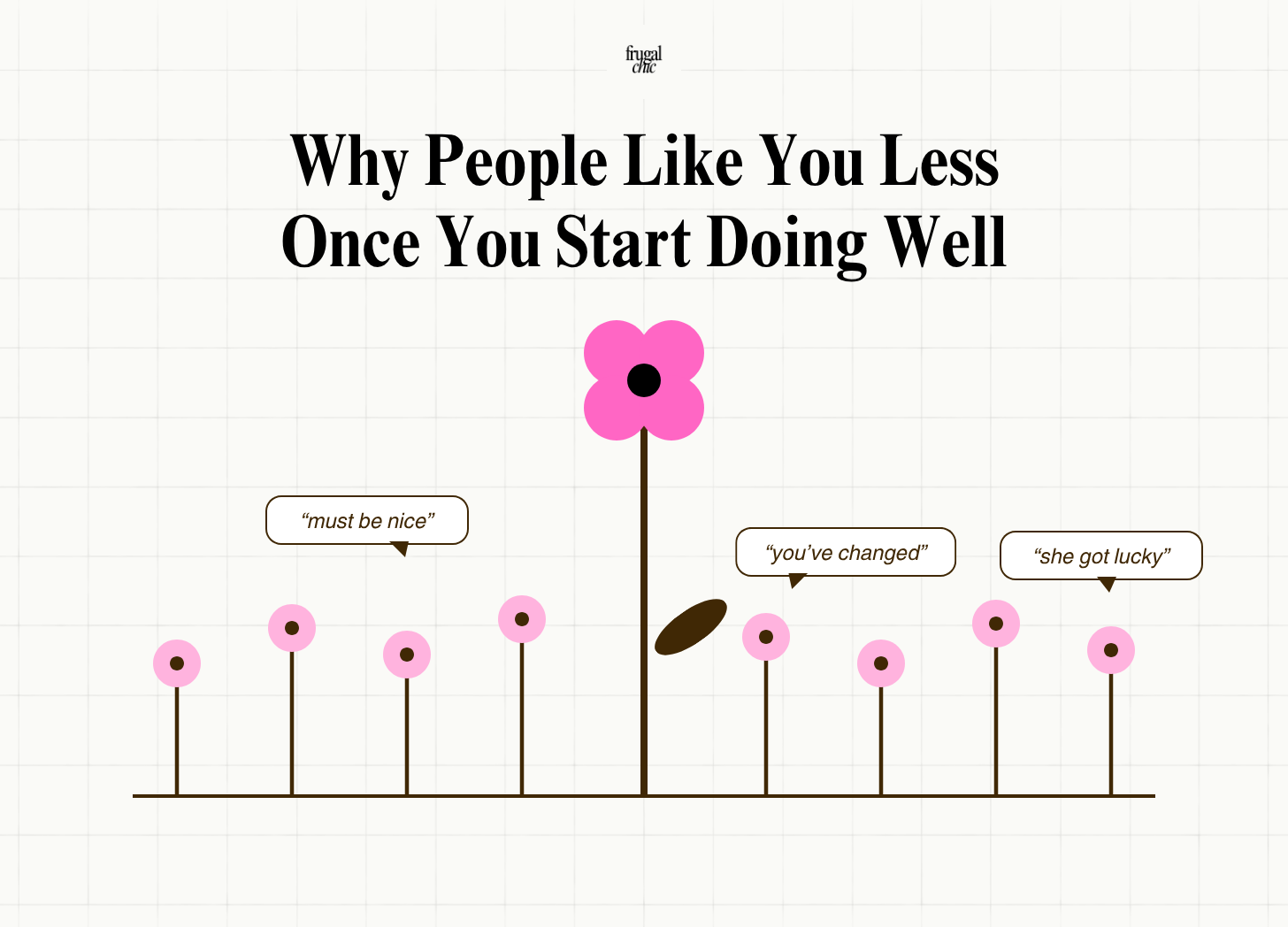
There’s an arc here, and once you see it you can’t unsee it. When you’re the starving artist or the naive junior, people root for you. Then you start to do well. Your name gets known, your income goes up, and the same people start treating you a bit differently, there’s less warmth, more little jabs, comments that start with “must be nice”.
I’ve felt this, and if you’re a woman who has done well at anything, I’d bet you have too. So this week I want to name it, explain why it happens, and talk about the strange middle bit that nobody warns you about.
In this issue:
Why everyone loves an underdog, right up until she wins
Tall poppy syndrome: a 2,500-year-old habit with very modern numbers
The awkward middle: too successful to be relatable, not successful enough to be aspirational
The brain scan that put envy and pain in the same place (I checked)
The very British habit of saying “I just”, and what it costs you
Everyone loves an underdog
The underdog is a mirror. When you’re struggling, people look at you and see themselves. Backing you costs them nothing and it feels good, because you’re proof that their situation is normal. You’re someone who gets it.
The second you stop struggling, the mirror cracks. You are no longer evidence that their life is normal. You’re evidence that it could be different, and that is a much less comfortable thing to look at.
Nothing about you changed. What changed is what you now represent to them.
It’s the tall poppy syndrome
You’ve probably heard the phrase. The origin is worth knowing. The Roman historian Livy tells a story about the last king of Rome, Tarquin, whose son sent a messenger asking what to do with the leading men of a city he’d just taken control of. The king said nothing. He walked into his garden and knocked the heads off the tallest poppies with his stick. The son got the message.
The modern term took off in Australia and New Zealand in the 1980s, where cutting down the tall poppy is practically a national pastime, and anyone who has lived there will tell you Britain has it just as badly. We just call it “don’t get too big for your boots”.
It also has numbers. In 2023 a study called The Tallest Poppy surveyed 4,710 working women across 103 countries. Nearly 87% said they had been cut down because of their success. 77% had their achievements downplayed. Six in ten believed they would be penalised if they were seen as ambitious at work. And here is the money bit: a large share said they’d responded by downplaying their achievements or not sharing them at all. Hiding is expensive. You cannot negotiate a rate for work nobody knows you did.
You can watch it happen to successful British women in real time. Grace Beverley, who built TALA and … before she was 25, has said that people tend to put anything to do with online success, especially women’s, “in a box”. During lockdown she was criticised for sharing productivity tips and then criticised for telling people to rest.
Krissy Cela, who built Oner Active from a fitness account she started while studying law, has spoken about people still looking for reasons not to credit her success to her.
Isobel Lorna. At 19 she was working night shifts at an Amazon warehouse and filming TikToks in between. People loved her for that. “Save the pennies and the Porsche will buy itself” was the whole brand, and for years she was the one who gets it. Then in September she launched Agende, her planner-and-handbag, and sold £250,000 worth in the first hour, with over 100,000 people on the waitlist before she’d even shown the product. Within a day the conversation wasn’t about the seven years that led there. It was “no hate but I thought they’d be max £100”.
Different women, same situation. The moment the hard bit stops being visible, people decide you got lucky.
The awkward middle
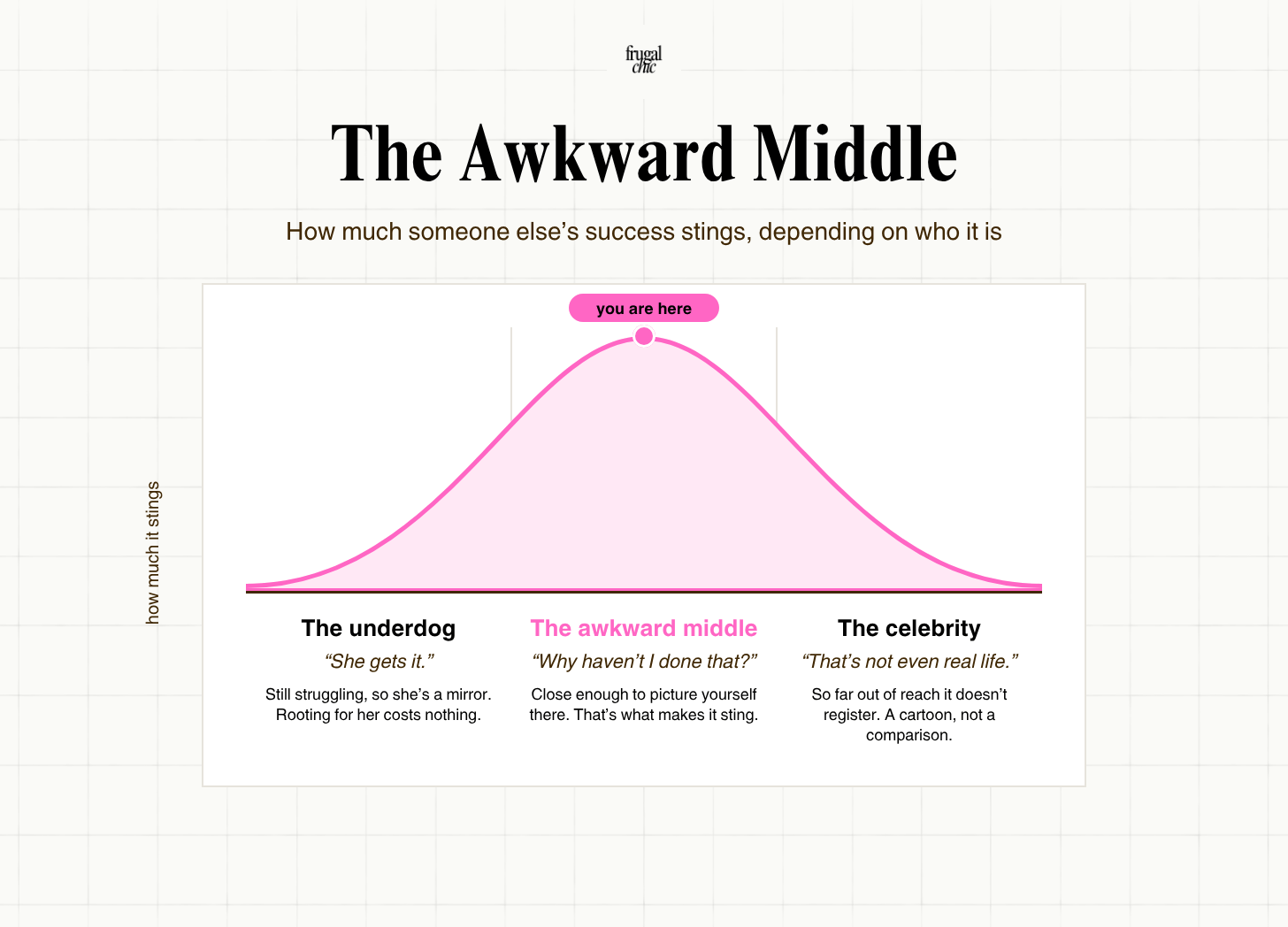
Nobody is jealous of a celebrity. Their lives are so far from ours that it doesn’t register. A yacht in Monaco is a cartoon. It costs you nothing emotionally to scroll past.
Then there’s the middle, which is where I am. I’ve done well enough to be called unrelatable, but not so well that I’m completely out of reach. And it turns out that is the worst place to stand. Nobody looks at a yacht and thinks “why haven’t I done that?” They think it about the girl from their course who just bought a flat.
Aristotle wrote this down about 2,300 years ago. In the Rhetoric he says we envy those who are near us in time, place, age or reputation, and we don’t compete with people far above or far below us. His phrase for it was “potter against potter”. When it’s someone you know, their success is a gentle jab, a reminder and it raises a question about your own life that a celebrity never could.
So if you’re in the middle and it feels oddly lonely, that isn’t paranoia. The middle is the most envied place there is, precisely because it looks reachable enough.
Envy actually hurts (I checked)
I saw a Reel recently claiming that envy lights up the same part of the brain as physical pain, and I wanted to know whether that was true before I repeated it. The short answer is yes, with a caveat.
In 2009, researchers in Japan put 19 students into an MRI scanner and had them read about fictional peers. The more the participants envied a character, the more activity showed up in the anterior cingulate cortex, a region heavily involved in processing pain, particularly the unpleasant, distressing part of it. Then the envied character suffered a misfortune, and the brain’s reward system lit up instead. The more painful the envy had been, the bigger the reward when they fell. The study was published in Science and it’s still the one everyone cites.
The caveat: it was 19 people, and “same region” doesn’t mean envy feels like a broken arm. But the broader finding, that social pain and physical pain share machinery in the brain, has held up over the years since.
Which changes how you read the “must be nice” comment. You’re not watching someone be cruel. You’re watching discomfort look for somewhere to go. And when you feel it yourself, scrolling past someone else’s win, that sting is information. It’s telling you exactly what you want.
“I’m just a content creator”
A personal example, because I haven’t given you many. When I was at Cannes Lions, I noticed the Americans could introduce themselves so much more easily. “I’m the CEO of this.” “I’ve built that.” An elevator pitch every time they shook a hand. We Brits did the opposite. “Oh, I’m just a content creator.” “I just make videos.” “I’m sort of in between things.” And then we were surprised when people took us at our word and treated us as slightly less.
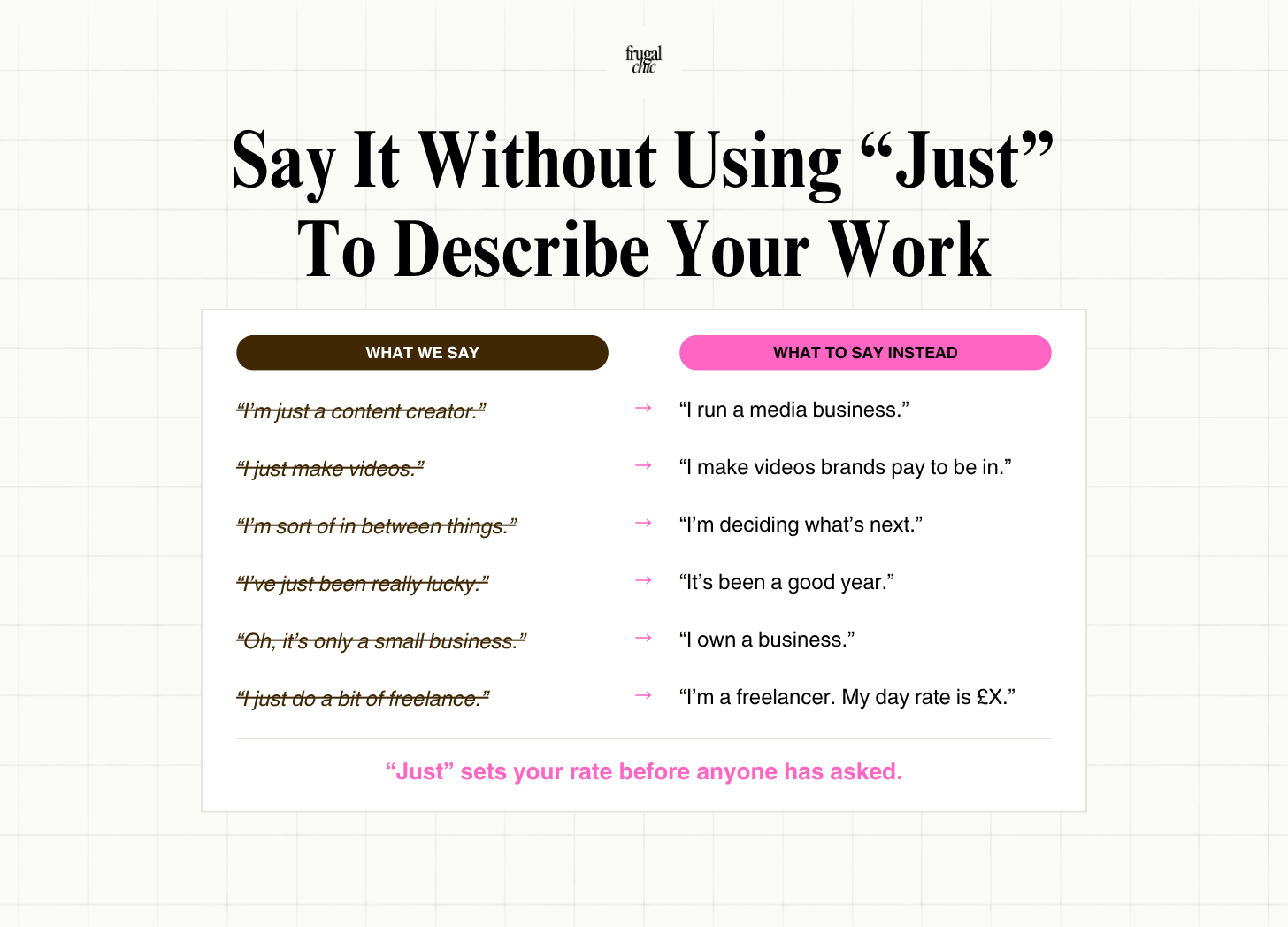
The anthropologist Kate Fox calls this the modesty rule in Watching the English: a prohibition on boasting so strong that advertising has to be rewritten to comply with it. We underplay as a reflex, at this point i’s practically a dialect.
It is also a discount. “Just” sets your rate before anyone has asked. If you walk in as “just a freelancer”, you have already told the room what you cost. There is now an actual campaign about this, Project Ambition, launched this year by the founder of HelloFresh and a venture capitalist, to make Brits less reserved about their ambition. The fact that it needs a campaign tells you everything.
The Frugal Chic® rule: Shrinking doesn’t make you more likeable. It just makes you cheaper.
What to do about it
You can’t stop people cutting poppies but you can stop handing them the stick.
Say what you do in one sentence, without “just”. “I run a personal finance newsletter and a business.” Full stop and let the silence sit.
Stop pre-apologising for things going well. “It’s been a mad year, I’ve been so lucky” is a discount too. Try “it’s been a good year”.
Let the mirror people go. Not everyone who rooted for the underdog wants the winner. That is about what they needed from you, not about who you are.
Keep your own receipts. The years at £0, the evenings and weekends, the thing nobody saw. When someone says you got lucky, you don’t have to argue. You just have to know.
Use your own envy. When someone else’s win stings, write down exactly what you want. Then go and make a plan for it instead of a comment about it.


This week, do one thing
Introduce yourself to one person this week without the word “just”. Say the full sentence, the real one, and then stop talking. Notice how little happens next, and how differently they treat you.
The key takeaway here is: being cut down is not evidence that you’ve done something wrong. It’s evidence that you’ve grown past the point where you’re a comfortable mirror for everyone around you. The feeling they have isn’t about you. It’s about what you now represent. Your job is not to shrink back to a size that makes it go away.
You didn’t change. You grew. Those are different things.
That’s all this week,
Mia xx
P.S. Wednesday’s post is the practical half of this one: the identity upgrade. The ten habits of the woman who earns double what you do now, from how she introduces herself to what she stops apologising for, with a short audit so you can see which ones you already have and which one to start this week. If you’ve been meaning to upgrade, this is a good week for it.
So refreshing and so completely true! The middle is the hardest part but the true friends & supporters shine for you in this time & it weeds out the rest! Keep killing it!! X