


There’s a thing that happens when you go back to your childhood bedroom.
You can be 26, with a proper job, a pension and opinions about olive oil. Then you walk through that door, see the same ceiling, and within ten minutes you’re lying on the bed scrolling, half waiting to be called down for dinner.
You’re not imagining it, and there’s a proper reason for it, which we’ll get to. But it’s a small example of something much bigger that I don’t think we talk about enough: where you live doesn’t only decide what you pay. It shapes what you earn.
In this issue:
What the same job pays in different parts of the UK
Why big cities make you better at your job, even after you leave
Why ambition is contagious
What really changes when you leave your childhood bedroom
The catch nobody mentions, and how to borrow a better postcode for free
Your postcode is on your payslip
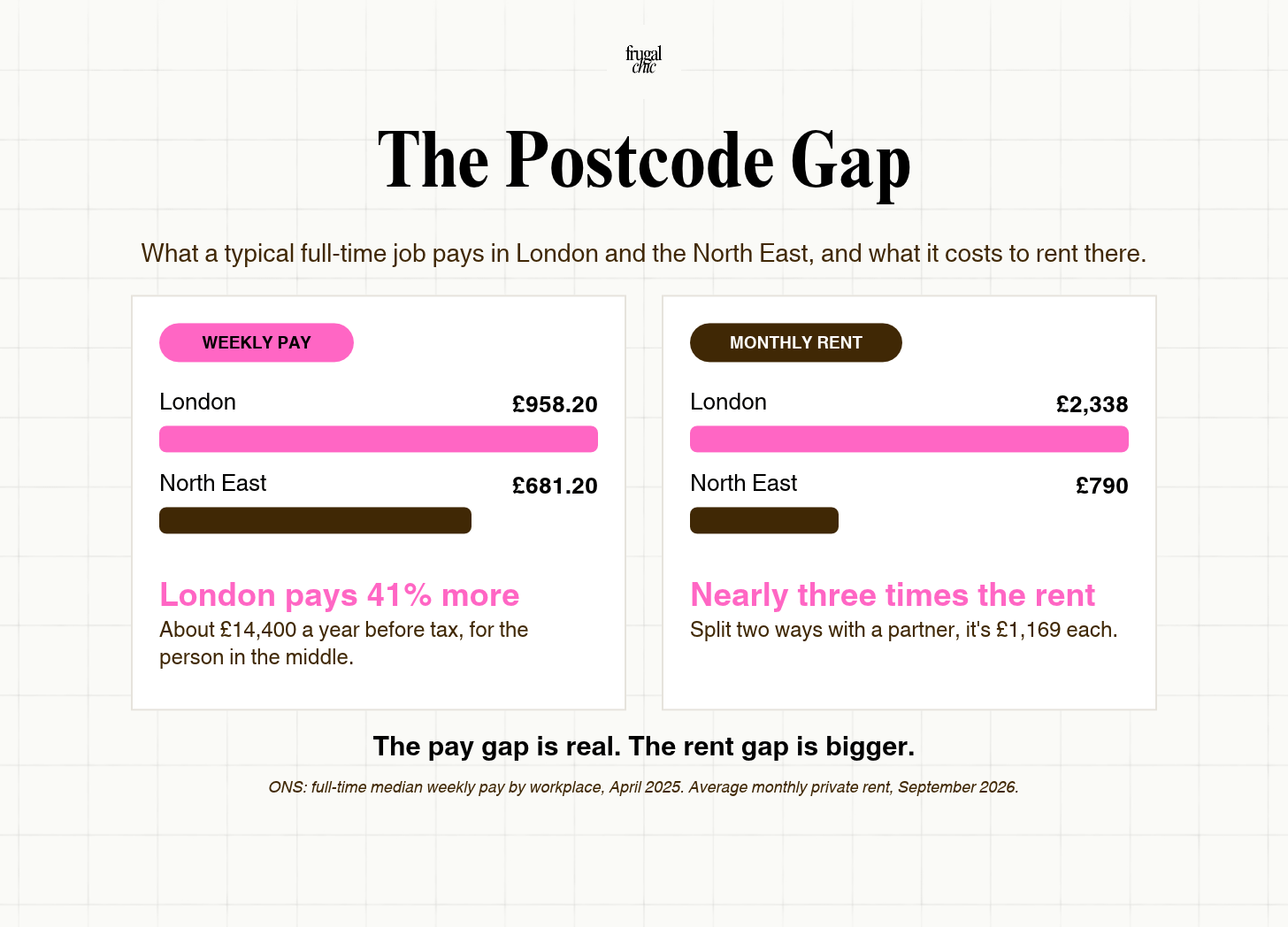
In April 2025, the typical full-time worker in London earned £958.20 a week before tax. In the North East it was £681.20. That’s around £14,400 a year for the person right in the middle, purely because of where the job is. And in this year’s figures, published in October, London had the fastest pay growth of any region, at 8.2%.
Before you start looking at flats in Zone 2: London rent averaged £2,338 a month in September, against £790 in the North East. The pay gap is real. The rent gap is real too, and on paper it’s bigger. This is not a post telling you to move to London.
The more interesting question is what a place does to you over time. Economists Jorge De la Roca and Diego Puga followed workers’ careers in Spain to work out why people earn more in bigger cities. The big-city workers weren’t more talented to begin with. They got a pay bump straight away, then learned faster, so their earnings grew faster. And when they left, the value of that experience went with them.
A bigger pond pays more and teaches more, and you get to keep the teaching.
Ambition is contagious
You’ve probably heard the saying that you’re the average of the five people you spend the most time with. That’s a motivational quote, it is not a study. What I’m about to share is a study.
Economists Alexandre Mas and Enrico Moretti tracked supermarket cashiers and how fast each one scanned. When a fast cashier joined a shift, the others sped up: a 10% rise in how productive your colleagues were lifted your own effort by about 1.7%. But it only worked when the fast cashier could see you. Nobody was told to work harder. They just didn’t want to be the slow one in the room.
Then the one that made me sit up. Raj Chetty and his colleagues linked the patent records of 1.2 million inventors to where they grew up. Girls who grew up somewhere with more women inventors were more likely to become inventors themselves. Growing up around male inventors made no difference to them. The researchers estimate that if girls saw women inventors as often as boys see men, the gender gap in invention would halve.
It is very hard to want a life you’ve never seen anyone live, especially someone who looks like you.
Who you know, and who you bump into
Networking has a terrible reputation. The evidence for it is annoyingly good.
LinkedIn ran experiments on more than 20 million members over five years, changing who its People You May Know feature suggested, and 600,000 new jobs were recorded over that time. The connections that helped most weren’t best friends or close colleagues. They were moderately weak ties: people you know a little and don’t talk to much. Your closest people helped least.
Which makes sense if you ask me. Your best friend knows the same people you do. The woman you met once at a birthday dinner knows and has been in a completely different set of rooms.
Then there’s remote work, because plenty of you are reading this from a home office, and a few of you from that childhood bedroom. A study of software engineers at a Fortune 500 company found that sitting near their teammates got engineers about 18% more feedback on their work, and their work improved. The benefit went mostly to younger and newer staff. Women lost out more when everyone went remote, partly because they asked fewer colleagues for feedback when they couldn’t just turn round and ask.
Working from home saves you the train fare. In your twenties, it might be costing you somewhere else.
Leaving your childhood bedroom
Now, let’s discuss the concept of the childhood bedroom.
Nearly three in ten 20 to 34 year olds in the UK lived with their parents in 2025, and more than a third of young men did. Housing costs are a big part of that. In plenty of families it’s simply what you do until you marry or buy, and financially it’s often the smartest room in the house: the Institute for Fiscal Studies found that 14% of 25 to 34 year olds living at home saved more than £10,000 over two years, against about 10% of similar people renting.
So I am not telling anyone to move out. Saving a deposit from your old single bed is extremely Frugal Chic.
But there’s one thing the bedroom can’t give you, and it explains that ten-minute regression. Psychologist Wendy Wood found that around 43% of what we do every day is habit, repeated in the same place while our minds are somewhere else. Places cue behaviour, and your childhood bedroom is full of cues for the person you were at 15.
Moving breaks those cues. Researchers at the University of Bath tested this with 800 households: the same nudge to change everyday habits (greener ones, in their case) worked better on people who had just moved house, and the window lasted about three months. In plain English, the first three months somewhere new are when a new routine is easiest to start.
And if you’re moving in with a partner, you’re doing more than splitting the rent, though that matters: London’s £2,338 becomes £1,169 each, which changes the maths in section one quite a lot. You’re also choosing who sets the tone at home. A five-year study of 4,544 married people found that having a conscientious partner, the organised, reliable, does-what-they-say kind, predicted more job satisfaction, higher income and more promotions. They didn’t do their partner’s job for them. They took on more of the running of the house, made home life easier, and their habits rubbed off.
The catch, and how to “borrow” a better postcode
Here’s what the “move somewhere better” advice leaves out. A better postcode raises the pressure to spend, too.
Economists matched lottery winners in one Canadian province with their neighbours’ bankruptcy records. The bigger the win, the more likely the people next door were to go bankrupt: around 2.4% more likely for every extra $1,000 won. They spent on things everyone could see, like cars, and borrowed to do it.
That’s the Frugal Chic problem in one study. The rooms that raise your ceiling also raise the cost of being in them. So go in for the people and the learning, and leave the lifestyle at the door.
What I’d do, wherever you live:
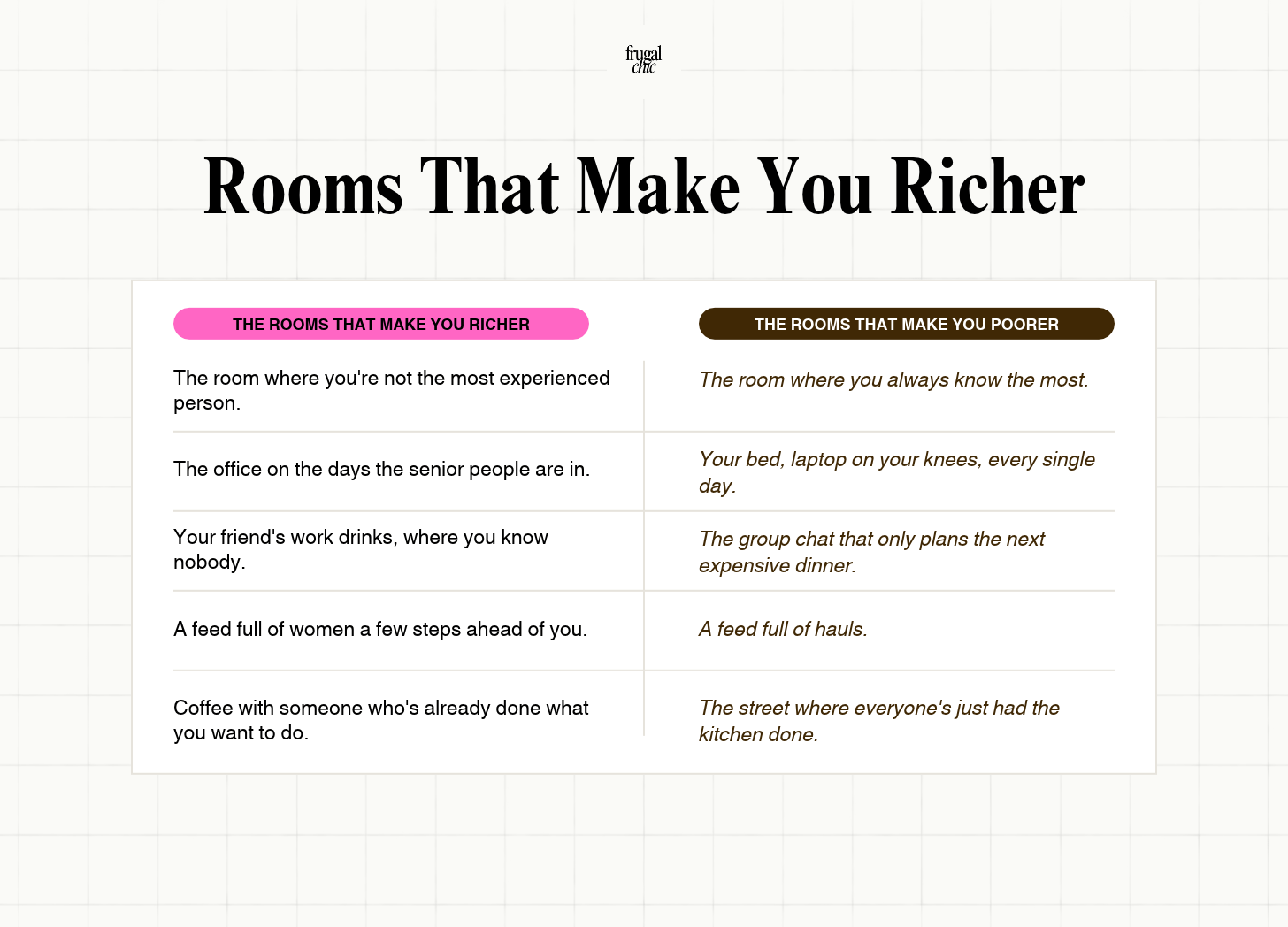
Go into the office on the days the senior people are in, not just the days it’s quietest.
Get yourself into one room a month where you’re not the most experienced person there: a talk, a course, a run club, a friend’s work drinks.
Message one weak tie a week, someone you know a bit. It feels like nothing. Twenty million LinkedIn members say otherwise.
Follow women who are a few steps ahead of you, online and offline. You’re resetting what feels normal.
The Frugal Chic® rule: Live where you can afford. Spend your time where you can grow.
This week, do one thing
Look back at the last seven days and count the rooms you were in where you weren’t the most experienced person there. If the answer is none, book one before next Sunday.
Key takeaway: Where you live won’t set your income on its own. It sets what you see, who you meet and which habits come easily. Choose those on purpose, wherever your postcode is.
That’s all this week,
Mia xx
P.S. On Wednesday, paid subscribers get the environment audit: a short, scored check of the people, rooms and habits around you, plus the changes worth making depending on where you are at in life.
Very well said, so true 👏👏
Love this!!