


Did frugal chic only work when i earned less?
There’s been a quiet question circling around my content lately. Am I still frugal? Has Frugal Chic changed? Did it only make sense when I was earning less?
I understand why people ask. When income changes publicly, people try to anchor you to a previous version of yourself. So I want to reintroduce Frugal Chic properly.
Frugal Chic was never about a fixed income. It was about a way of thinking. And that way of thinking can move with you.
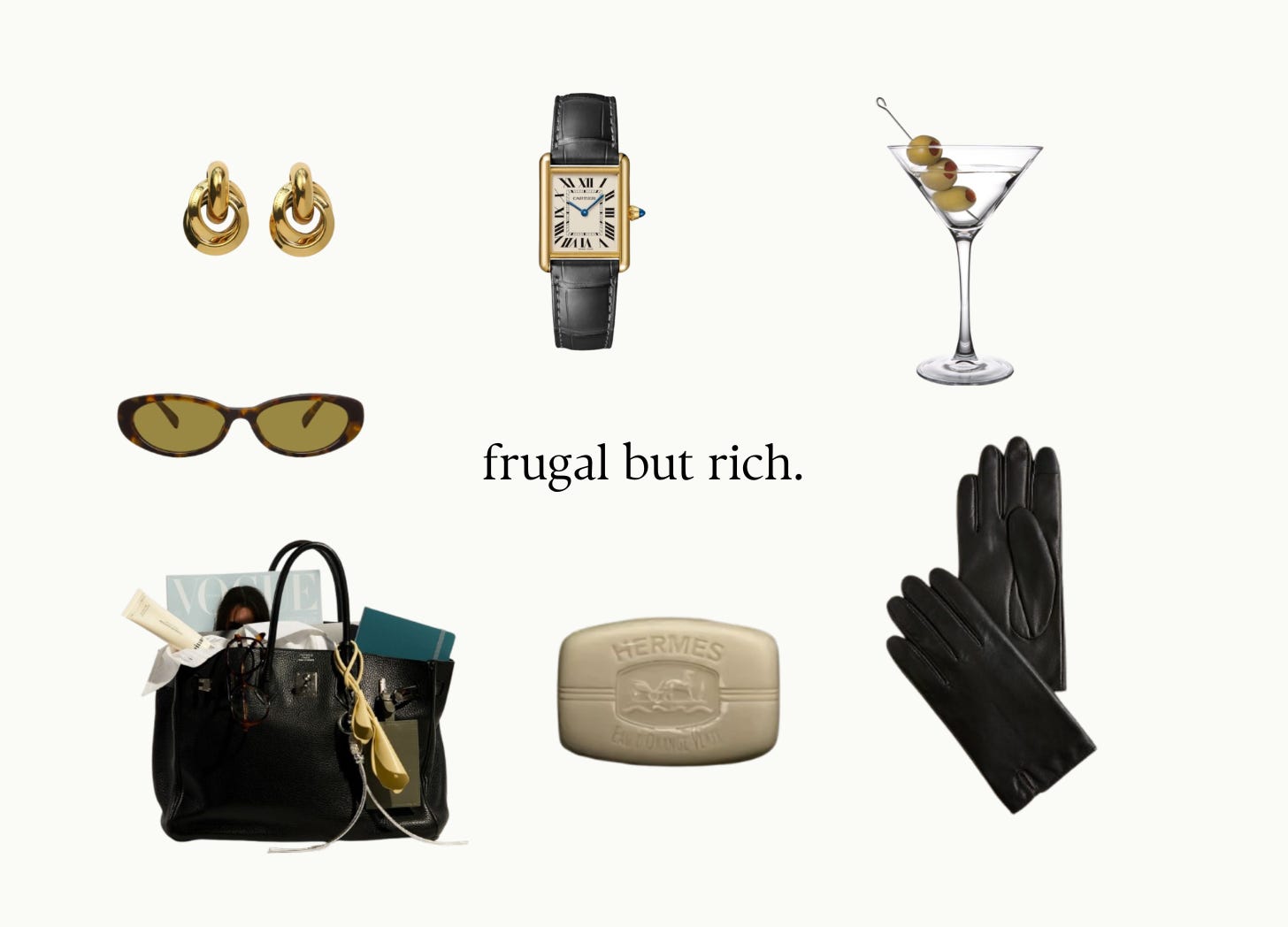
In this issue:
• What “frugal” really means
• The difference between cheap and frugal
• Why value-based spending and frugality are the same idea
• How my spending evolved from £30k a year to £30k months
• Why discipline matters more as income grows
What “frugal” really means
Let’s start with the word itself.
Frugal is often associated with penny pinching, not wanting to split the bill or cosplaying poverty. This is why you get people saying ‘doing x isn’t frugal’, if it’s traditionally seen as a luxury.
Here’s why that thinking is misguided.
At its core, frugal simply means intentional spending. It is choosing where your money goes instead of letting impulse, comparison or pressure decide for you.
Many people say they do not believe in frugality but believe in value-based spending. In reality, they are describing the same thing. Value-based spending is simply a gentler way of saying that you spend in alignment with what matters to you and reduce what does not.
Perhaps the avoidance of identifying as frugal is because they feel they’ll be forever trapped in a certain aesthetic or behaviour, almost like a limiting belief. But many rich people are frugal. Their version of frugality can even look extravagant compared to someone on minimum wage, it’s all relative.
The problem is, the internet likes to put things into neat boxes, frugality must mean minimalism, neutral palettes, no luxury in sight.
But frugality isn’t a look, it’s a decision making framework.
Cheap vs frugal
There is also an important nuance between being cheap and being frugal.
Cheap focuses on the lowest price in the moment. It can mean buying poor quality repeatedly. It can mean avoiding necessary costs. Over time, cheap decisions can become expensive ones, like wearing poorly made shoes that impact your walking, only eating instant ramen and eventually facing the health consequences.
Frugal, on the other hand, is long term. Frugal might spend more upfront for quality and longevity. Frugal considers opportunity cost. Frugal asks, “What has the highest ROI”. It’s financial intelligence in action.
It is also worth acknowledging that many people are forced into cheap decisions because that’s all they can afford to do. This is why being cheap is expensive, ironically.
From constraint to restraint
When I was on £30k working in fashion, frugality looked like constraint. I was living at home, which is a privilege I fully acknowledge. I used that season to save 50-70% of my income while my other friends at home blew it all on holidays and going out. I did not move out prematurely. I did not stretch my salary beyond what was sustainable.
After moving out, I doubled down on my side hustle. I worked in the mornings, evenings and weekends. When I eventually decided to go full time, it was not the safest financial decision on paper. I did not have guaranteed income. I did not have consistent five figure months (I didn’t even think it was possible for me to earn that much!!). What I had was momentum and belief.
That decision was not reckless. It was strategic. I was reallocating my time into something with greater long-term upside.
Over time, income changed. Five figure months became consistent. Recently, I had a £50k month. Understandably, that shifts perception.
In that month, I spent £1.9k. Roughly 3 to 4 percent of my income.
For me, that is still frugal.
The difference is this: at £30k a year, frugality was about constraint. At higher income levels, frugality becomes restraint. The difference is choice. You can afford more, but you choose not to expand your lifestyle at the same rate as your income. You essentially choose to use that disposable income to buy freedom instead of lifestyle.
Restraint could be perecived as deprivation, I see it as financial taste. To be tasteful, it’s more about what you say no to, what you don’t like as opposed to what you do like. It’s cleverly filtering out the noise, and the same goes for your finances.
The middle ground
Frugal Chic has always been about that middle ground. Neither extremes are helpful for building wealth. If you focus too much on counting the pennies you’ll never focus on what truly moves the needle, increasing your income. At the same time, if you spend all the money you make - or worse get into debt trying to keep up, you’ll be forever trapped living paycheck to paycheck, no more money would help you.
Frugal Chic is about realising that style and strategy don’t have to oppose each other.
Transparency as a creator
As a creator, there is an added layer. There are gifted experiences, PR packages and brand partnerships. Transparency matters to me because my platform is built on financial literacy. But receiving something or occasionally buying something expensive does not automatically contradict the framework.
What would contradict it is mindless excess. What would contradict it is spending to signal status rather than to build stability.
The question that matters more is savings rate. People pull random figures or examples out of context, like going for a luxury staycation isn’t frugal, or buying an £8 smoothie isn’t frugal - they might be if the budget allows for it.
Frugal Chic was never about staying small. It was about staying intentional.
Frugality is not something you graduate from once you earn more. If anything, higher income requires more awareness. It’s not a trauma to overcome. Larger numbers create larger consequences, and therefore high earners can definitely also practice Frugal Chic.
⸻
Action points
1. Redefine frugal for yourself as intentional spending, not deprivation. Write a splurge vs saves list, this ensures you have purpose behind your frugality.
2. Calculate your spending as a percentage of your income, not just a raw number. It’s easy to say someone that spends £5k a month isn’t frugal, but what about if they have kids, a mortgage, family obligations. Context and income matter.
3. Distinguish between constraint and restraint in your current season. Are you limited by income, or choosing discipline?
4. Set a lifestyle baseline you would feel comfortable maintaining even if your income fluctuated. Write out all your non-negotiable expenses.
5. Allocate income growth deliberately. Let investments and assets grow first, then adjust lifestyle gradually and consciously. Buying a Chanel bag might not seem frivolous at all if you have paid off your mortgage, or you already reached an investment goal for example.
Appearing modest for the sake of it is just as damaging as appearing rich to prove a point. At the end of the day, your finances are your finances. As long as you are living below your means, you’re Frugal Chic.
That’s all this week,

This is like Rich dad, poor dad. But for girls!
Thank you, Mia. This is insightful