


Since the new show, Love Story came out, which centres on late 90s style icon Carolyn Bessette Kennedy and John F. Kennedy Jr, the internet has started emulating her look. Pinterest boards, get the look videos, capsule wardrobe breakdowns. Everyone is hopping on the bandwagon.
It’s understandable why.
Blue jeans, a black headband, tortoiseshell shades. These are readily available items that most people already own some version of.
While it’s valuable to have fashion inspirations and draw from icons, it rarely translates in the same way. More often, we recreate outwardly rather than pausing to ask whether those specific pieces actually align with our current lifestyle.
The only risk I see is that you end up getting pulled into trends, into whatever the current flavour of the month is, instead of developing a real sense of personal style, which isn’t something you can buy overnight.
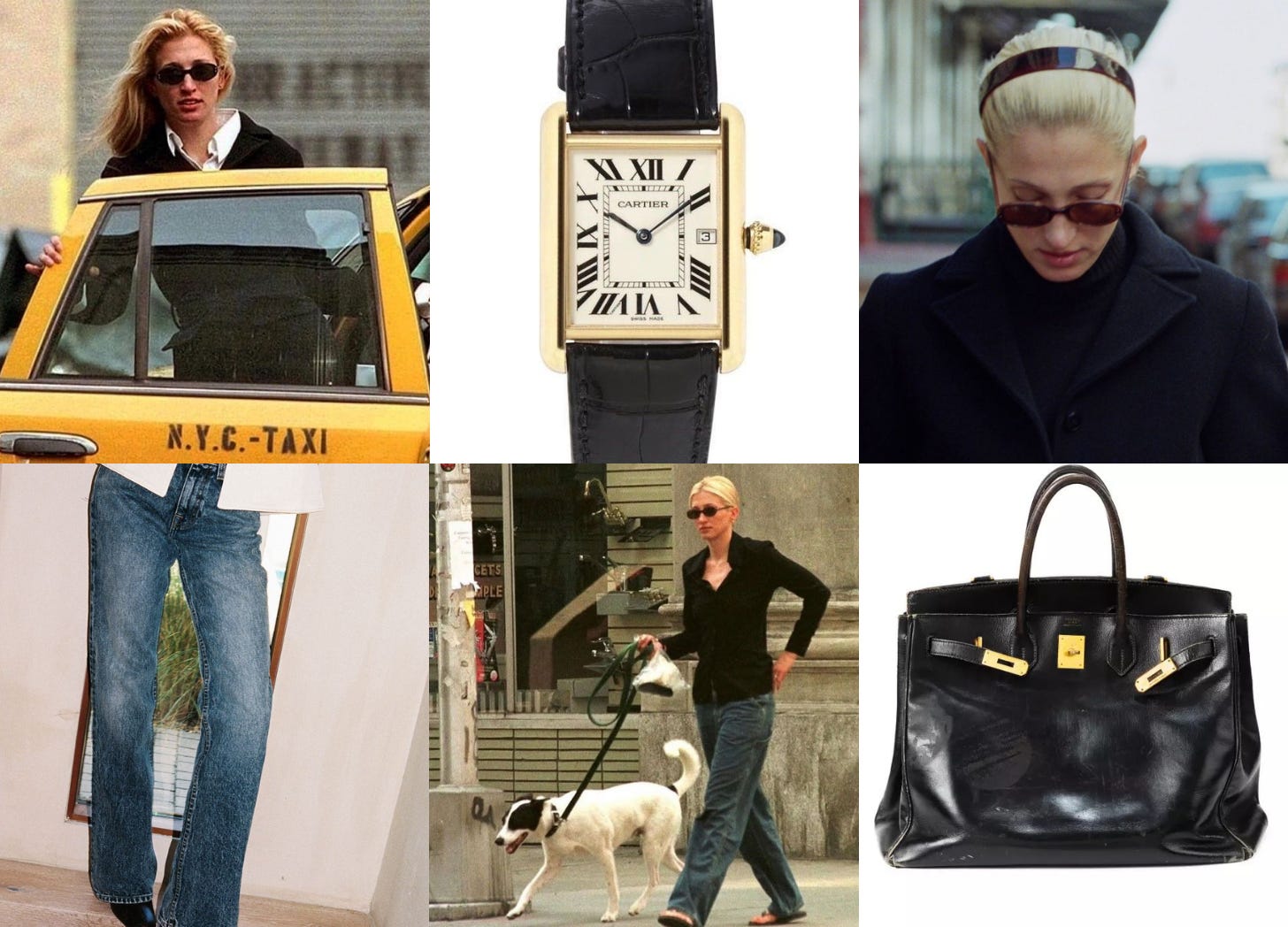
And that’s exactly what’s happening with Carolyn Bessette-Kennedy.
You can reduce a woman to a uniform far quicker than you can understand the conditions that produced her.
Here at Frugal Chic, we’re going to pause that instinct to cut and paste.
Because copying her is missing the point entirely.
in this issue:
why copying her style doesn’t work
the missing layer: discernment
how her lifestyle shaped her wardrobe
minimalism as control, not aesthetic
how to build taste, not just outfits
She’s our Frugal Chic muse, not because she was financially frugal, but because visually, she was. It’s about what her taste represents.
Minimalism is usually framed as an aesthetic choice. Frugality as a financial one. But they come from the same place: making decisions under constraint.
Both require you to say no more than you say yes. And in that repeated refusal, something starts to take shape. Discernment.
That’s where she sits. And more importantly, that’s why her image still feels relevant in a world constantly pushing you towards more. More options, more trends, more consumption, more visibility.
Her style feels calm not because it’s simple, but because it’s grounded. There’s a level of confidence there that can’t be bought or copied overnight. It didn’t come from a template or an influencer’s recommendation, it came from a life that was actually lived that way, not performed.
why this trend keeps failing
If you closely examine the GRWMs, the styling videos, they’re not bad but something feels off.
The proportions, colour palette, references might be spot on, but imitation is never as good as the original. The issue is, people often start with an aesthetic to imitate, a visual aid. Then the person attempts to reverse-engineer their life around it.
Carolyn’s style worked in the opposite direction. It was built from her life outward. She wasn’t dressing to communicate something new every day. She wasn’t using clothing as a performance. She wasn’t trying to be seen in a particular way. She was dressing to feel aligned with her lifestyle, what made sense for her own circumstances.Most modern style advice optimises for attention rather than alignment. What will look best on the feed, what is considered “chic” right now, how quickly you can adapt to the next micro-trend.
Now, I’m not claiming to be the most chic or stylish person, but after spending over two years working in luxury wholesale, I was constantly around people who were. People who had spent years refining their taste, pulling from fashion history, understanding design, treating style almost like an extension of art. What I noticed is that the most stylish people weren’t experimenting endlessly, they had a kind of uniform they returned to. And it wasn’t easy to copy, because it was so specific to how they actually lived.
So what if it’s less about copying the clothes, and more about adopting the filter she approached them with in the first place?
the missing layer: discernment
Discernment is not just “having good taste”. It is the ability to filter.
To stand in front of ten options and immediately eliminate nine, not because they are objectively bad, but because they are unnecessary. Carolyn had that. We often think taste is a trait only the elites are born with. Sure, having money, time, and the many privileges that come with that make it easier to practise taste.
However, sociologist Pierre Bourdieu argued that taste is a form of cultural capital. It is discernment, the ability to filter through noise and recognise what a society considers refined, valuable, or desirable. There is no universal version of what taste is, only standards that groups agree upon, often without realising it. Once you understand that, taste starts to feel like a muscle you can train. It is available to anyone willing to train their eye.
Carolyn’s ability to discern wasn’t innate, it was trained. Her time at Calvin Klein in the 1990s placed her at the centre of a very specific aesthetic philosophy. Calvin Klein at that time was not about decoration. It was about reduction. Removing everything that did not serve the form.
Moreover, working in a PR there meant her job was to control perception. She was constantly thinking about how things read commercially. What feels effortless on camera. What holds up under scrutiny. What becomes timeless versus what dates quickly.
It’s easy to assume her style was an automatic extension of her class or simply a byproduct of her lifestyle, but what appeared effortless on the surface was underpinned by a high level of intention and thought.
she dressed for her life, not an audience
Then layer on the fact she lived in New York.
Not the cinematic version we recall from films, but the lived-in version. Walking, commuting, existing in public spaces. Clothing has to be functional and versatile. Jeans and loafers, wool coats and boots, all very comfortable but stylish. Think classics that look better with wear, not worse.
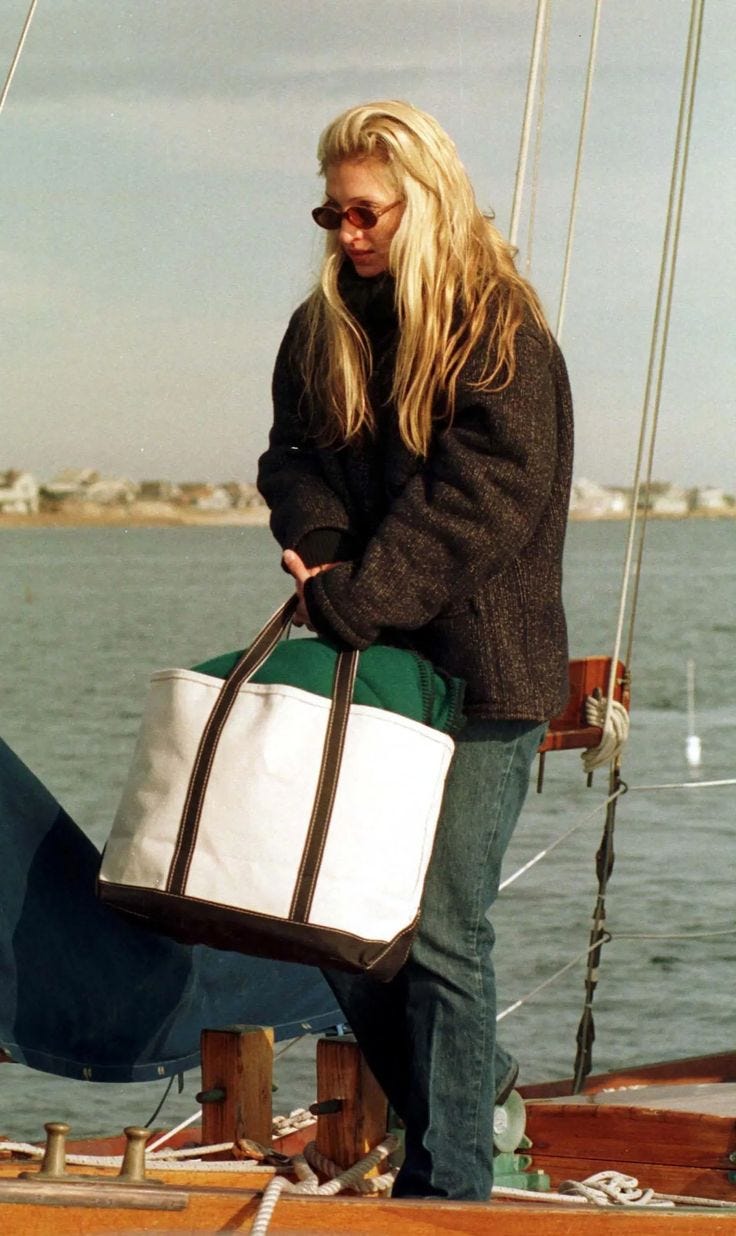
And then layer on visibility.
Being married to John F. Kennedy Jr. meant living under constant surveillance. Photographed relentlessly, analysed endlessly, yet she was publicy as reserved as her fashion sense was. There is famously almost no recorded footage of her speaking. Her style suggests she treaded lightly, avoiding attention and controversy. Being in the public eye came with a level of pressure and scrutiny that most people would struggle to tolerate, where even the smallest choices were picked apart and turned into something bigger than they were.
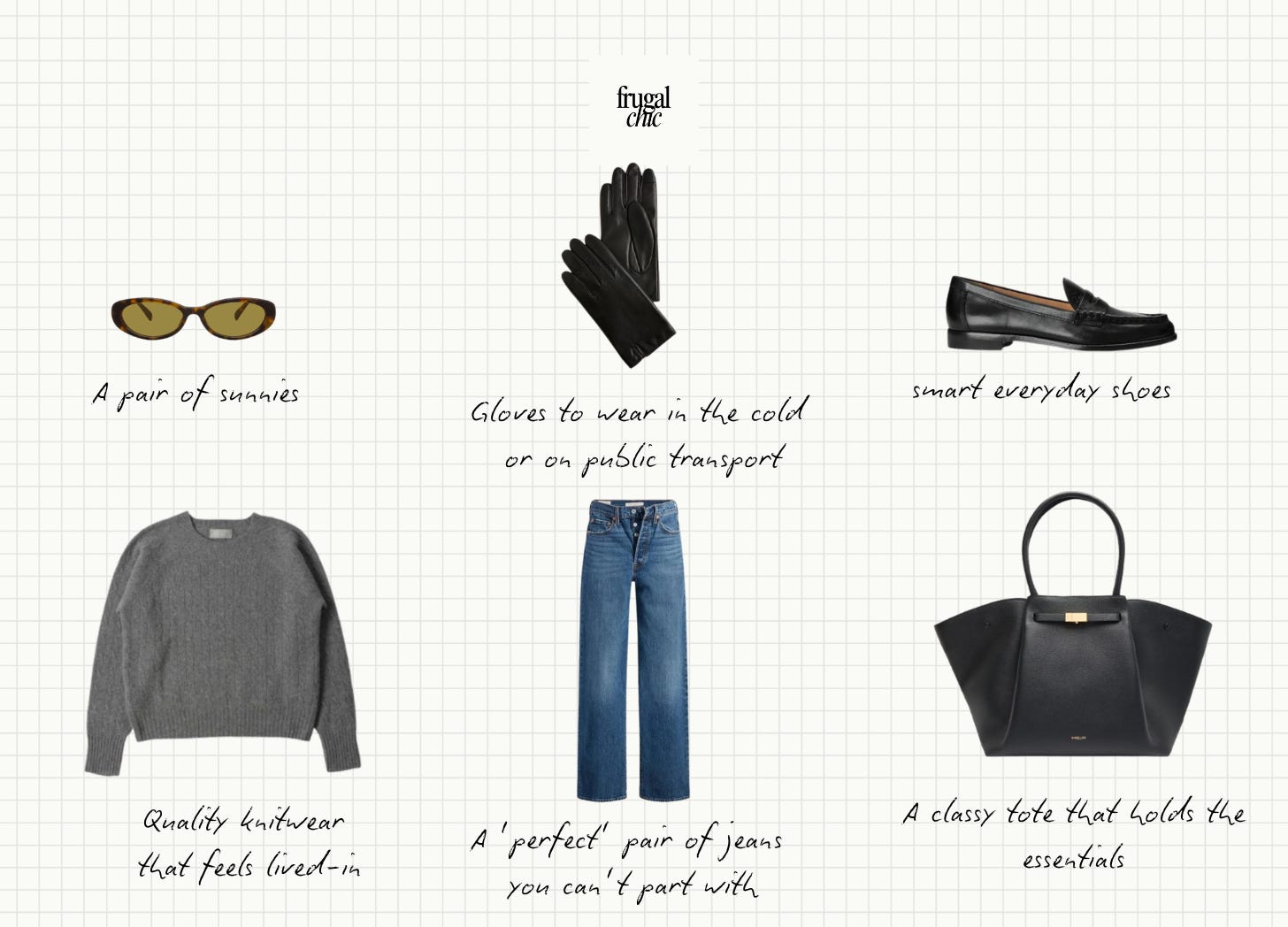
The irony is, her wardrobe wasn’t aspirational in the way people assume. It was functional. Editors and stylists consistently point out that she “knew what worked and repeated it”, with nothing excessive or unnecessary (source). Neutral tones, clean lines, dependable options. Some see it as boring, but really it was about efficiency. Each item had a role which in turn reduced decision fatigue.
This is why her outfits feel effortless. They were selected from a system that had already been curated.
These are a few pieces that I interpret from this framework, but the point is, it looks different for everyone:
she was observed, not performed
It today’s world, everything is on show. Even as a content creator, I feel this, the pressure to be transparent. Part of what made Carolyn captivating was the mystery surrounding her. She existed in public, but she did not perform in public. There were no explanations, no captions, no behind-the-scenes context. She didn’t attempt to control the narrative through constant output. She was simply seen. In a strange way, that created more intrigue. Because when someone is not over-explained, you project more onto them. You study the details more closely. You try to understand the choices.
Although she was one of the most photographed people of that time, she kept a lot private, due to her class, the time, and her line of work.
Today, we do the opposite. We fill every gap. Every thought is shared, every decision explained, every outfit overanalysed.
It sounds obvious, but the takeaway is simple: if you want to be more authentic with fashion or develop a signature style, you have to stop comparing and stop over-explaining. Just re-wear what works, wear what makes sense for your life, and slowly curate your wardrobe over time, ignoring the noise.
the frugal chic translation
If you actually what to emulate her essense rather than copying and pasting the outfit, your process has to change.
Assess your current lifestyle. Your career, the climate, the pace of life. Where you go, how you move, what you need your clothes to do. It may not look like mid-wash jeans and loafers. It might be more outdoorsy, more corporate, or softer. The point isn’t the aesthetic, it’s the alignment with your own life. Minimalism isn’t just a sad beige life and timeless looks different for everyone.
Reduce. Not in a dramatic declutter by a gradual process. Remove what doesn’t get worn, what doesn’t feel right, what doesn’t serve a purpose. My favourite hack is using the money I make selling old things to buy more secondhand clothing, almost creating an infinite fund for shopping (if you buy things that don’t depreciate too much in value). Therefore, buying more becomes a slow iterative process rather than a quick fix.
Refine. Pay attention to the variables that matter. Fit, fabric, proportion. Making an effort to check the care label each time you buy something. Checking the seams for quality. Pay close attention to how fabrics feel next to the skin. The whole ‘buy it nice or buy it twice’ can seem tone deaf, but the point isn’t to go out and buy a whole new designer wardrobe for £1,000, it’s to very slowly incorporate this knowledge of quality into future choices.
Commit. Stop rebranding every season. Stop chasing every micro-aesthetic. Let your style stabilise. No-buys and low-buys aren’t just financial decisions, they’re psychological. They show you what you actually wear when shopping isn’t a distraction or a hobby. I’m doing a challenge over on short form where I buy 12 items in a year. The goal isn’t some arbitrary number, it’s only selecting the one most valuable item that month (if there is one, or else I buy nothing).
Mystery. If you’re not using social media to build something, there’s no need to treat it like a performance. Either stay private, or use it more lightly, as a tool to observe and refine your taste rather than chase validation. Think of those low-key, insider-feeling feeds. Random, zoomed-in objects. Candid moments. Slightly unpolished. Still curated, but not engineered for approval like highly stylised feeds. There’s something freeing in that. It shifts posting from being seen to seeing. From performing to noticing. More like a digital diary. A place to collect what you’re drawn to, what you return to, what actually reflects you.
You don’t want Carolyn Bessette-Kennedy’s style.
You want her eye for quality. Her taste. Her restraint. That quiet sense of mystery.
You’re probably never going to fully replicate it, but that’s not really the point. In trying, you end up sharpening your own standards.
You start buying less, but better. Making decisions quicker, but with more certainty. You stop dressing for some imaginary version of how you think you should look, and start dressing for your actual life.
And in a world that constantly pushes you towards more, that level of discernment isn’t just aesthetic, it’s financial too.
That’s all this week.

I love your posts, thank you from Tahiti 🫶🏼🌺