


The convenience tax is never one big decision and I think that’s what makes it so expensive.
It’s the delivery fee on a Tuesday because you’re tired, the taxi home when the bus would have been just fine, the insurance you let roll over because the renewal email looked long and you promised yourself you’ll tackle later, the savings account you opened years ago and haven’t looked at since.
None of those feel like much. Together, they’re one of the biggest bills most people pay, but it never arrives as a bill.
If you read Sunday’s post on having an expensive aura without spending money, you’ll know I think the most expensive-looking thing you can be is intentional. This is the money version of that. Comfort isn’t the problem. Comfort you never actively chose is.
In this issue:
Why the convenience tax is actually two taxes, not one
What happens to your money when you get too comfortable
What it adds up to over a year, and over ten
Framework 1: the three-colour audit
Framework 2: the hour test
Framework 3: the friction rule
Framework 4: Switch Day, with my checklist and the exact words I use on the phone
The comfort test for anything new
Where it goes wrong
Obviously, nothing in this post is financial advice. It’s how I think about my own money, and it depends entirely on your circumstances.
It’s actually two taxes, not one

When people talk about paying for convenience, they usually mean the obvious stuff. However, there are two very different things going on, and they need different fixes.
The ease tax is what you pay so you don’t have to do something. Delivery instead of cooking, an Uber instead of the bus, next-day shipping instead of waiting. You’re paying someone else for the effort. I am the first to admit that sometimes that’s a brilliant trade but I can put my hands up and also admit that sometimes it’s just habit.
The inertia tax is what you pay because you didn’t do something. The savings account paying next to nothing, the subscription that renewed, the contract you’re still on two years after it ended, the insurance that went up because you didn’t get a quote. You’re not paying for anyone’s effort here, you’re paying for not looking close enough.
The ease tax at least buys you something. The inertia tax buys you nothing at all, and it’s usually the bigger of the two.
What happens when you get too comfortable
Small costs go invisible. A £14 subscription doesn’t feel like money. But the government estimates people in the UK spend £1.6 billion a year on subscriptions they no longer want, at an average of around £14 a month each. Nobody decides to waste that. It just keeps leaving the account while you’re busy.
Defaults are designed for the company, not for you. The standard savings account, the rollover tariff, the renewal quote. Bank of England figures show around £306 billion sitting in UK accounts that pay no interest at all, and AJ Bell estimates that money is missing out on more than £12 billion a year compared with an account paying 4%. When Hargreaves Lansdown asked savers why they don’t switch, 11% said they probably should but can’t be bothered. If I was to summarise it, that’s the inertia tax in one sentence.
Your baseline creeps up. Convenience starts as a treat and quietly becomes normal. Once a Tuesday delivery is normal, cooking feels like effort, and effort starts to feel like deprivation. That’s how a £25 habit ends up feeling like a need or a well deserved treat.
Comfort gets into your career too. Staying in a role because it’s easy, not asking for the pay rise, never checking what the market pays for what you do. That’s often the biggest convenience tax of all, and it never shows up on a bank statement.
What it actually adds up to
Here’s a fairly ordinary version. There is nothing extravagant here, just four things that don’t feel like big decisions but will make a difference in your finances.
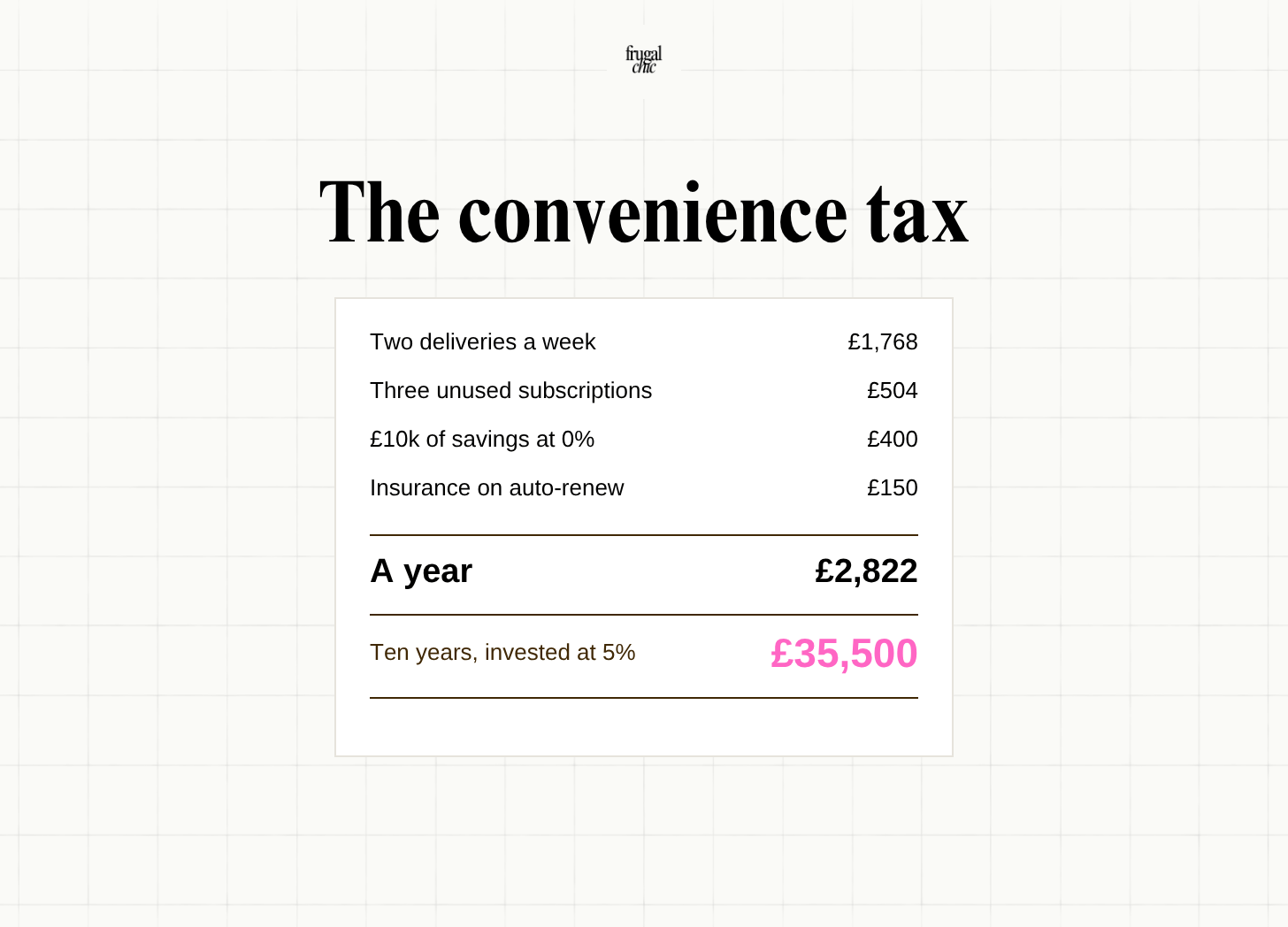
Two takeaway deliveries a week at around £25, against roughly £8 to cook something similar at home: £1,768 a year.
Three subscriptions you don’t really use, at £14 a month each: £504 a year.
A £10,000 emergency fund sitting at 0% instead of in an account paying 4%: £400 a year.
Letting the car insurance auto-renew instead of getting quotes, say £150 more than you needed to pay: £150 a year.
That’s £2,822 a year and about £235 a month, gone on things you never actually chose.
Now say you redirected it instead, and it grew at 5% a year. After ten years, that’s roughly £35,500. Same person, same salary, same life. The only difference is a few afternoons of admin and fewer deliveries.
That’s what I mean when I say comfort is expensive. It isn’t the odd £25, it’s the £25 on repeat, with nothing working for you in the background.
There are some easy ways in which you can tackle this and make the convenience tax lower for you.
