


Happy Sunday!
I’ve been thinking a lot lately about the fear of putting yourself out there.
I struggled a lot with confidence growing up. I was the shy, quiet kid, too afraid of even answering the phone, who’d get heart palpitations whenever “get into groups” was mentioned at school, whose palms would sweat when my parents forced me to go to army camp (yes, I did act like Sacha Baron Cohen in Brüno, iykyk).
But fast forward 10 years to now: I’ve somehow become someone who literally gets paid to yap. To give my insights and experience, even when I am not the person who has the most knowledge in the room.
Sometimes I stop and think about how strange that transformation actually is.
I often wonder how different my life would be if I had stayed in that comfort zone of anonymity and quietness. I wrote recently that there was a time I didn’t have ANY social media, and it was an extremely peaceful time of my life. It was calm. It was quiet.
But it was also a time where my growth stagnated.
I wasn’t getting opportunities. I wasn’t meeting people who thought differently. And I held a lot of limiting beliefs, like thinking being successful or rich came down to luck or good looks alone.
Which led me to a realisation.
If you are more on the introverted side, you quietly pay what I think of as the “introvert tax.”
You let others speak for you.
You say yes to things you don’t really want to do.
You isolate yourself.
You get easily embarrassed in public situations.
You overthink every social interaction.
And over time, this quietly blocks a lot of opportunities.
Not just social opportunities, but financial ones too. Because the people who tend to benefit in the long run are the ones willing to raise their hand, share their ideas, or simply be visible.
The introvert tax often means you end up sitting on the sidelines rather than being the main character in your own life.
And this doesn’t come out of nowhere.
It could be a personality trait.
It could be growing up feeling like other siblings or relatives shone brighter socially.
It could be being taught to be overly polite.
It could be being told to stay quiet and let other people speak.
Or feeling that your voice, especially as a woman, wasn’t as valuable.
For me, I can trace some of it back to being an adoptee and growing up always feeling a little bit like the “alien”, the odd one out.
Being quiet became my way of not drawing any more attention to myself.
But over time, I realised something important.
Quietness itself was never the real problem.
Quietness isn’t a flaw
When you grow up being on the more reserved side, people often say things like “you’re too quiet” or “you need to speak up more.”
Interestingly, no one ever tells people who are too loud that they should be quieter.
Quiet people tend to be better listeners. There’s a certain wisdom you obtain from observing, waiting, and calculating. Like a game of chess, you allow the other person to reveal their weaknesses or vulnerabilities first.
But the world often rewards audacity.
The loudest person in the room, the person who shouts the loudest, even if they are not the most qualified or knowledgeable, often ends up getting the opportunities.
This is why teachers tell kids to speak up more in class. It’s why charismatic personalities often get promoted faster.
For years I felt like quietness was a defect to fix, an ailment to cure.
So I tried to adopt a more gregarious personality.
The problem was that it wasn’t authentic to me.
When you treat quietness like a flaw to fix, you end up overcompensating. You try to become someone else entirely.
What I eventually realised is that you can still make an impact, make change, and establish authority without changing your personality.
Noise and power are two very different things.
There is a difference between someone who shouts the loudest and someone who commands respect. The person who selects their best and most valuable ideas. The person who says less, but better.
Quietness can absolutely be a strength.
The only real cost is when quietness turns into invisibility.
When you stay silent, constantly put others first, and spend huge amounts of energy trying to avoid embarrassment.
Because embarrassment was never the real problem.
Embarrassment is the cost of admission
The truth is life is embarrassing.
I love the phrase that was going around on short-form recently (apologies, I couldn’t find the original creator) that every choice we make while alive is essentially a humiliation ritual.
Working in corporate often means pretending to care deeply about maximising shareholder value.
Being freelance can mean unpredictable months and times where work is completely dry.
Not putting yourself out there often leads to mediocrity, because that’s the path of least resistance and it’s what most people are doing.
Whatever path we take, we will encounter some form of embarrassment.
To be completely honest, the TEDx talk didn’t go as I’d planned.
I stumbled on my words, and there was about 30 seconds where I completely froze. The only thoughts going through my head were:
“Don’t throw up.”
“Don’t faint.”
“Don’t faint and throw up.”
Reflecting on it now, I hadn’t prepared as much as I should have. I should have been able to recite it word for word through muscle memory. With a few weeks’ notice, I should have taken it more seriously.
But something that reassured me afterwards was that someone came up to me and said the hesitation actually made it feel more human and relatable. Another speaker told me that the actual content of what I was saying was really inspiring.
What I took away from it was this:
It was terrifying. But it was also an amazing thing to even get the chance to do.
My mentality going into it was simple.
I will regret not doing this far more than I will regret doing it and making a fool of myself.
And that’s often the real choice we’re facing.
We tell ourselves that if we don’t do the thing, then we have nothing to lose. We can just stay home, stay safe, stay comfortable.
But what we’re really doing is quietly paying the introvert tax again.
How I overcame the fear of being seen
Posting a talking video online was something I never thought I would do.
So what actually got me to start posting content, to go on panels and talks, when I believed the way I was had already been “set in stone”?
Honestly, it started by accidentally tricking myself.
My logic with starting TikTok was that I assumed people I knew in real life wouldn’t see it.
The FYP and algorithm create a strange psychological effect. Even if a video gets 50k views, it still just feels like a number on a screen. It doesn’t feel like 50,000 real people watching you.
I’m not saying that’s the healthiest mindset, but that’s genuinely how I thought about it at the start.
So I treated it like a game.
A code to crack.
Every post was a chance to improve and understand how it worked. The game was free. It didn’t require leaving the house, signing up for a course, or massively putting myself out of my comfort zone.
It just felt like a digital diary.
A place to talk about a subject I’d never really been able to share with people in person.
And what happened next genuinely changed the course of my life.
The opportunities that come from putting yourself out there
For me, it’s led to getting paid my yearly salary in one month, going on brand trips, receiving PR, and being invited to cool events.
But more importantly than any of that, it gave me a way to make money on my own terms.
No micromanagement.
No waiting for permission.
I genuinely never thought I would be able to make my own independent living at 25. I assumed starting my own business would happen in my 40s, if it happened at all.
Putting myself out there accelerated that timeline in a way I never expected.
And this isn’t just about social media.
Even if you’re building a traditional business, you will still need the confidence to pitch yourself to investors, meet agencies, entertain clients, and network with people you’ve never met before.
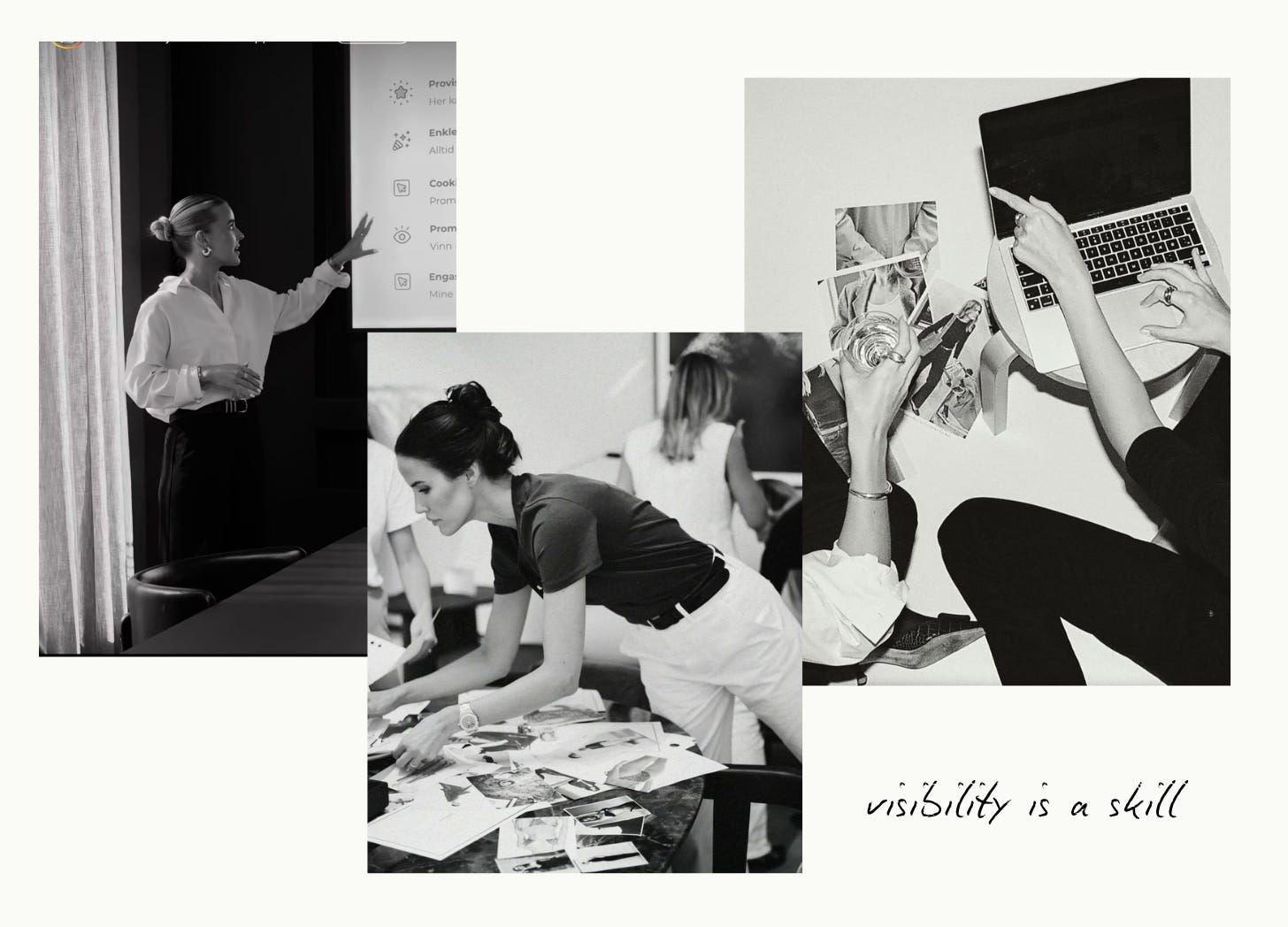
Visibility is a skill.
And like any skill, it can be learned.
Actionable steps you can implement today
Write one LinkedIn post about a recent event, project, idea, or opinion.
Before you say, “Well nothing worthy of writing about has happened lately,” I don’t care. It could be an opinion, a lesson, an observation. Visibility is everything. If you can’t bring yourself to talk on TikTok yet, pick a safer, more traditional medium and get your ideas public.
Create one page that you are going to be consistent with.
Don’t treat it as being an influencer. Treat it as a work diary. And when I say work, I mean your life’s work. The real problems you’ve solved in your own life. You don’t necessarily even have to talk. It could be written in blog format.
When you’re next in public, make an effort to make small talk with a stranger.
I know this feels odd in London. People here are slightly less open to random conversations. But it could be as simple as when you get your daily coffee, actually asking the barista how their day really was.
We think small talk doesn’t mean anything, but it’s often the first step to connection. And sometimes that small moment means more to someone else than you realise.
Film yourself talking for one minute.
Yes, it will probably feel cringe. But it can be incredibly useful. You don’t even have to post it anywhere. It’s just practice. Notice how often you say filler words. Observe your delivery. Don’t judge yourself too harshly.
Write down five social traits you like about yourself.
Maybe you give great compliments.
Maybe you always remember people’s names.
Maybe you remember small details about people’s lives.
A strange thing about confidence is that it rarely arrives before you do the thing that requires it.
Most of the time, it shows up afterwards.
You do the uncomfortable thing. You post the video. You say the opinion out loud. You go to the event even though you feel slightly awkward the entire time. And then later you realise… nothing catastrophic happened. In fact, something good usually does.
The truth is that putting yourself out there doesn’t suddenly turn you into a different person. I’m still someone who needs quiet time to recharge. I still overthink things. I still feel nervous before speaking on a stage or posting something slightly controversial online.
But the difference now is that I don’t let those feelings make the decision for me.
Because the real risk isn’t embarrassment. The real risk is staying invisible.
When you think about it long term, the opportunities in life almost always go to the people who are willing to be slightly uncomfortable in public. The ones willing to say something first, try something first, raise their hand first.
So if you’ve been sitting on an idea, a project, a piece of writing, a business, or even just an opinion you’ve been too nervous to share, consider this your gentle push.
The world doesn’t need you to be the loudest person in the room.
But it does need you to stop paying the introvert tax.
Quick catch up: what a hectic but fun few weeks I’ve had. From going on the Matt Allwright show on Channel 5 on live TV, doing a TEDx talk at the University of Manchester, having a gifted stay at the Four Seasons Hampshire, and going to a brand event with Female Invest. It’s safe to say it’s been pretty tiring, but I couldn’t be more grateful.
I hope you’ll be able to forgive me for dropping the frequency of paid-only content recently. After April rolls around, I will have a LOT more capacity to be making complimentary guides, goodies, and extra resources again, which I’m really excited about.
That’s all this week,

Wow. What a beautiful piece of writing.
"But the world often rewards audacity."
That sentence in itself was so powerful. It reminded me of the dangers that come with staying within our comfort zone. Of what little changes occur when we allow fear to be in the driver seat.
This was so beautiful! Thank you so much. ❤️ I have been wanting to put myself out there for the last year socially online and in person, it feels terrifying! Like standing on the edge of a cliff to post something whether that be my life or professionally. LinkedIn is my first attempt.