


What if having more money doesn’t actually make you want more things?
Lately, I’ve been thinking about the point where upgrading your life stops improving it.
So let’s talk about how to define your ‘enough’ and identify your Chic Ceiling.
In this issue
Why spending more doesn’t always improve your life
The psychology behind getting used to upgrades
How over-optimisation can actually make life feel worse
Why owning more creates its own mental load
How to work out where your own Chic Ceiling is
Why spending more doesn’t always improve your life
Consumerism sells us a lie that by just buying enough, we’ll be complete. The ‘hot’ or ‘cool’ girls are wearing xyz. Everything has an aesthetic version of the everyday thing: hand soap, tea towels and even, surprisingly, sardines. This has culminated in an upgrade culture. There is a constant temptation to consume, to optimise both ourselves and our surroundings, but at what cost?
I’ve felt this shift. Becoming a high earner and being around entrepreneurs for most of the week, I stick out like a sore thumb. I got told the other day to buy myself a milestone gift for writing a book, namely a bit of jewellery or a watch. I’ve always wanted a Cartier Tank. I just think they’re timeless and incredibly tasteful. But as I’ve gotten older, built a £100k+ investment portfolio and a six-figure business, it somehow just doesn’t interest me anymore. I would probably be happy with a smaller-brand lookalike.
I can completely understand the sentiment behind this. Every time they looked at their milestone gift, they’re reminded of a huge achievement. But for me, I just don’t need a material thing to signify I have made it in some way. I can just reflect on my career, take a long walk through nature, look at pictures and celebrate with friends and family. That’s not to demonise material goods. I am still one to splurge on quality clothing, that’s my value, and maybe someone else values watches, but the point stands that as my life and situation with money got better, my appearance and possessions didn’t require an instant upgrade.
Once I could afford to, I no longer wanted to buy it.
I still wear the same cardigan to podcasts because it’s timeless and good quality. I wear the same silk polka dot dress to most events I go to (and I go to a lot, like three a week). I still live in the same flat with an unaesthetic kitchen and dreary bathroom in Zone 2 because that still makes sense for my life. I love the idea of owning a home, renovating it, and starting to collect home decor, but that’s the point: I know I like the idea of it, but not necessarily the reality.
I know it sounds a bit cliché, but I think this happens to a lot of financially savvy people once they get money.
For one, it took so long to reach a large investment pot, that now purchases are considered because that discipline muscle has been built.
Secondly, the push is no longer there. When something is just out of reach, it feels desirable.
Either way, I don’t see myself changing my spending habits any time soon.
The psychology behind getting used to upgrades
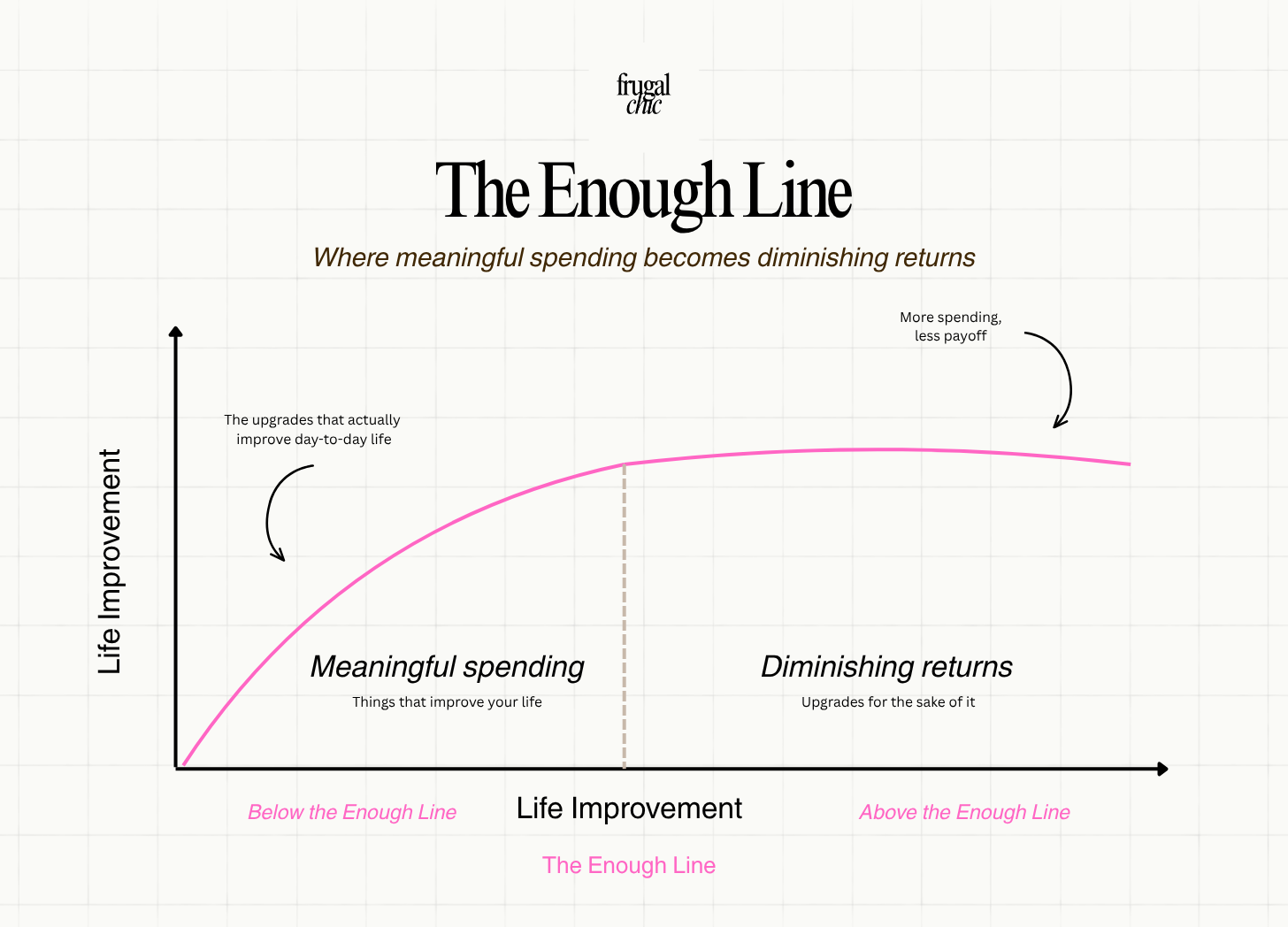
There’s actually an economic concept behind this called diminishing marginal utility. Essentially, the more of something you consume, the less additional satisfaction you tend to get from each extra unit.1
The first upgrade might make a huge difference. The next one, a bit less. Eventually, you can spend significantly more money for a very marginal improvement.
I think over-optimisation culture has made this harder to recognise because there is always another thing being marketed to us as an upgrade.
For me, it’s things like electrolytes when you don’t run or exercise enough to actually need them, or buying a new iPhone simply for the sake of having the newest iPhone, or another pair of trainers even though the ones you have look perfectly fine.
As you get more money, you should improve the things that matter. Things that help you feel healthier, safer, more fulfilled.
But often, that doesn’t come in the form of a haul.
When more starts creating more work
One of the reasons I think we have a ceiling is clutter.
Physically, you can end up with an overly cluttered space, which can start to cloud your mental headspace too. Your environment does matter. One study looking at how people described their homes found that women who described their homes as more cluttered or unfinished had less favourable patterns of cortisol throughout the day and poorer mood.2
Obviously, that doesn’t mean having a messy drawer is ruining your health, but I do think it shows that our physical environment has an effect on us.
You are also holding the weight of owning all of those items.
You have to store them, clean them, maintain them, mend them and eventually dispose of them. The more you own, the more there is to manage.
Honestly, I have started to feel this as a creator who verges on being a ‘lifestyle’ influencer. I try to be as selective as I can, only saying yes to PR from small fashion brands, makeup I actually use or skincare that I know I like. But in the midst of that, I could go to an event and get given a goodie bag, with no control of what’s inside.
Lucky me, but also, this piles up. I give a lot away to friends and family and yes, I am super privileged to even have this ‘problem’. But in a way, that makes my experience even more helpful for those who aspire to have ‘more’. 99% of these products I sadly don’t use, I still have a really simple routine. Suggesting that even if you did increase you income and acquire the 10-step skincare routine, it just isn’t always necessary.
In a similar vein, cleaning becomes more of a chore when every surface is covered in things. I’m not saying have empty shelves, but I don’t go out of my way to buy home decor or trinkets just for it to sit on a shelf.
At some point, you’re no longer buying something that makes your life easier. You’re giving yourself another thing to look after.
The Invisible Upgrade
A more powerful shift, I’d say, is making changes that aren’t immediately visible to others. This is a bit akin to that trend where people say, “If I won the lottery, there’d be signs,” but those signs are usually subtle or unusual.
This could look like:
More investments.
More time.
Cleaner.
Assistant.
Therapy/coaching.
Better sleep.
Shorter commute.
Emergency savings.
They’re a bit boring and unsexy, but that’s the point.
Some of these could result in a friend saying ‘you’re looking so well’, or ‘you look well rested’. You bought back time or mental headspace.
I’ve learned this as I transitioned from 9-5 to business owner.
The most common question I get asked all the time is, “How do I manage everything?” Posting every day on short form, once a week on long form and twice a week on Substack, while attending 3+ events and the occasional podcast or speaking gig.
The answer is: I get help. I have an assistant, editors and a coach. I work from home, and I chose to live 30 minutes from my old 9-to-5 office. I sleep 8+ hours a night and don’t have an alarm. I don’t have kids, and the list goes on.
Any upgrade I make now, I’m leaning more towards these kinds of things, because they give me more leverage.
The Chic Ceiling
Your personal maximum level of lifestyle spending where additional upgrades stop meaningfully improving your life.
Once you know what “enough” looks like for you, earning more doesn’t automatically have to mean spending more. The gap can go towards investing, saving, buying back your time or simply giving yourself more freedom.
So, ask yourself which parts of your lifestyle would genuinely improve if you spent more on them, and where you already feel completely satisfied.
For me, my Chic Ceiling is probably going on one nice holiday a year, buying some expensive but good-quality clothes very rarely, going out to eat with friends and family, maybe the occasional expensive meal and going to a luxury gym.
Beyond that, I have room in my budget to extend my lifestyle quite considerably.
In fact, I regularly have more than £1,000 of disposable income every single month that I could spend if I wanted to.
I choose not to.
Not because I’m forcing myself to save every penny or because spending money makes me feel guilty. There is genuinely nothing else I feel like I need in order to be happy.
And that’s quite a freeing feeling.
The more my income has increased, the more I’ve realised that there is actually quite a clear limit to how much lifestyle spending improves my day-to-day life.
After that, I would rather keep the money.
The Enough Line
To find this, ask yourself the following questions:
1. What genuinely improves my life here?
What am I happy to spend more on because I notice the difference?
2. What do I not care about?
Where would the cheaper, simpler version make me just as happy?
3. Where does the upgrade stop being worth it?
At what point am I paying significantly more for a very small improvement?
You can’t buy your best self. You become her when you finally stop chasing more.
---
That’s all this week,
Mia x
Mankiw, N.G. and Taylor, M.P. (2020) Economics. 5th edn. Andover: Cengage Learning. See discussion of diminishing marginal utility.
Saxbe, D.E. and Repetti, R.L. (2010) ‘No place like home: Home tours correlate with daily patterns of mood and cortisol’, Personality and Social Psychology Bulletin, 36(1), pp. 71–81. doi:10.1177/0146167209352864.
This maps almost too neatly onto baking. People buy the Dutch oven, the banneton, the proofer, the grain mill, and the bread does not get better, because equipment was never the variable. The only purchases that ever changed anything for me were the ones that removed friction, not the ones that promised a result.
Your point about leverage is the same idea. An upgrade either buys you attention and time, or it buys you the feeling of having done something.
It’s funny how you reach the point where you can afford the upgrade, and you realise you don’t really need it. The way you describe the move from visible upgrades to the invisible ones (time, headspace, rest) is exactly how I think about it too. That’s the kind of wealth that actually changes your life. The wealth of enough.